
Table of Contents
What Happens to Your Spine After a Crash, Work Injury, Sports Hit, or Hard Fall?

Overview
High-impact events push the spine far beyond its normal limits. Sudden flexion, extension, rotation, and compression—like what happens in a car crash, a workplace fall, a sports tackle, or when you hit your head—can strain soft tissues, shift joints, rupture discs, and even fracture vertebrae. In severe cases, the spinal cord is affected, resulting in changes to strength and sensation below the level of the injury. These same forces can also move the brain inside the skull, leading to concussions or diffuse axonal injury (DAI). A whole-person, integrative chiropractic plan—coordinated with medical imaging and rehabilitation—can help restore alignment, reduce pain, support nervous system function, and facilitate a safe return to activity. (Mayo Clinic, 2024; NINDS, 2025; UT Southwestern, 2025; Mesfin, 2023). NCBI+3Mayo Clinic+3NINDS+3
The Forces That Injure the Spine (and Brain)
When your body suddenly speeds up or slows down, your head and neck can whip forward and back or twist quickly. These rapid changes create:
-
Hyperextension/hyperflexion: overstretches ligaments and joint capsules (classic whiplash).
-
Axial compression: loads the spine from the top down; in sports, a head-first impact can cause neck fractures and serious spinal cord injury.
-
Rotation and shear: tear fibers in discs and brain white matter.
In sports, the highest-risk activities for catastrophic spine injuries include football, ice hockey, wrestling, diving, skiing/snowboarding, rugby, and cheerleading. Mechanisms often involve axial loading to the crown of the head with the neck slightly flexed. (Boden, 2008; Torg, 1985; Hutton, 2016). PubMed+2PubMed+2
These same quick acceleration–deceleration and rotational forces cause the brain to move and stretch nerve fibers, a core mechanism in concussion and DAI. (Mesfin, 2023). NCBI
Common Spine Injuries After High-Impact Events
1) Soft-Tissue Injuries (Whiplash, Strains, Sprains)
Rapid neck motion can irritate muscles, tendons, ligaments, and joint capsules. Symptoms include neck pain, stiffness, headaches, and limited range of motion. (Bowles & Verna LLP, 2022). Bowles & Verna
2) Disc Injuries (Bulges and Herniations)
A strong flexion/rotation load can tear the annulus of a disc. Herniated material may irritate the spinal nerves, causing radiating pain in the arm or leg, numbness, or weakness. (Miller & Hine Law, 2023; Grossman & Green, 2023). PubMed+1
3) Vertebral Fractures (Including C2 “Hangman” and Odontoid Fractures)
High-energy impacts (e.g., car crashes, diving) can cause fractures of the cervical vertebrae. A hangman fracture involves bilateral breaks through C2’s pars/pedicles from extreme hyperextension; odontoid (dens) fractures often involve hyperflexion or extension. These injuries may require immobilization or surgery, depending on the level of stability. (Torlincasi, 2022; Menger, 2023; McMordie, 2023). NCBI+2NCBI+2
4) Spinal Cord Injury (SCI)
A traumatic blow can crush, compress, or sever the cord or damage the vertebrae/discs around it. SCI changes movement, sensation, bowel/bladder control, and autonomic functions below the lesion; complications include spasticity, pressure injuries, respiratory issues, and bone loss. (Mayo Clinic, 2024; NINDS, 2025). Mayo Clinic+1
Motor-vehicle crashes are a leading cause of SCI in the U.S.; falls, sports/diving, and violence follow. (Mayo Clinic, 2024). Mayo Clinic
5) Vascular Injuries Around the Neck (BCVI)
Hyperextension with lateral bending/rotation can injure the vertebral or carotid arteries, risking stroke. High-energy motor vehicle collisions are a major cause; careful screening is vital. (Simon, 2023; Dunn, 2023). NCBI+1
Why Head Injuries Often Travel With Neck/Spine Trauma
The brain and cervical spine move together during impact. Even without a direct head hit, body forces can make the brain shift. This is why patients with neck pain after crashes or sports impacts also report dizziness, headaches, balance problems, or brain fog. DAI specifically originates from rotational forces that shear white-matter tracts, which can sometimes be invisible on initial CT scans. (Mesfin, 2023). NCBI
Sports data confirm the link between neck loading and brain injury risk; adolescent athletes show higher rates of upper/lower cervical fractures and SCIWORA, and they have notable rates of concurrent TBI across sports. (Alas, 2021). PubMed
Pediatric studies also highlight how TBI and cervical injuries overlap, making careful screening essential. (Weiss & Anderson, 2024; Luckhurst, 2023). MDPI+1
Immediate Priorities After Suspected Spine Injury
-
Assume a spinal injury with any head/neck trauma; do not move the person unless necessary. Call emergency services. (Mayo Clinic, 2024). Mayo Clinic
-
Immobilize to prevent secondary injury; early stabilization aims to limit ongoing damage to the cord. (Alaska Dept. of Health, 2025). State of Alaska | Department of Health
-
Imaging based on clinical rules and risk (X-ray, CT, MRI) to assess fractures, discs, ligaments, cord, and brain. (UT Southwestern, 2025; Mayo Clinic, 2024). UT Southwestern Medical Center+1
-
Watch for red flags (worsening weakness, numbness, breathing trouble, severe headache, repeated vomiting, or deteriorating alertness). (Hospital for Special Surgery, n.d.). Hospital for Special Surgery
How Spinal Cord Injury Affects the Body
-
Motor and sensory changes: weakness or paralysis (paraplegia/tetraplegia) and numbness below the level of injury.
-
Autonomic dysfunction: low blood pressure when upright (orthostatic hypotension), or dangerous spikes like autonomic dysreflexia in injuries at/above T6. (Mayo Clinic, 2024; Allen, 2023; Cleveland Clinic, 2022). Mayo Clinic+2NCBI+2
-
Complications: spasticity, bladder/bowel dysfunction, pressure injuries, respiratory infections, and bone loss—managed through a coordinated rehab plan. (Mayo Clinic, 2024; SCIRE, 2022). Mayo Clinic+1
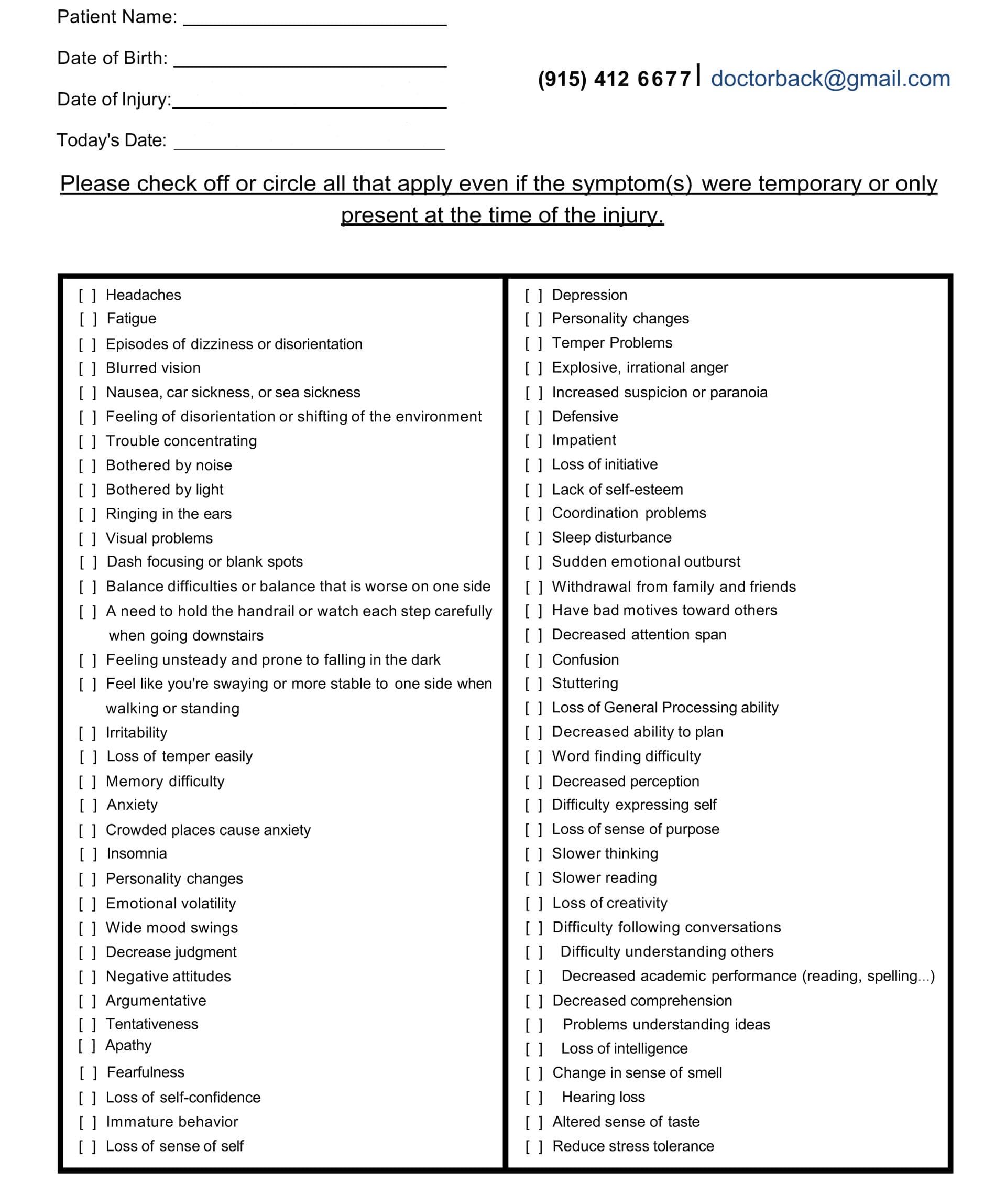
Head Injury/TBI Symptom Questionnaire:
Special Notes on the Neck: C2 Injuries and Hangman Fractures
The C1–C2 segment allows approximately 50% of neck rotation, resulting in high stress. C2 fractures are commonly odontoid or hangman-type; the treatment strategy depends on stability and alignment. (Menger, 2023; McMordie, 2023). NCBI+1
Brain Injury Mechanisms That Often Co-Occur
-
Concussion: brief changes in brain function following a bump/blow/jolt.
-
Diffuse Axonal Injury: rotational forces shear axons, leading to prolonged symptoms and, at times, coma; often not visible on initial CT. (Mesfin, 2023). NCBI
Because these brain injuries can occur without obvious imaging changes initially, clinicians integrate a comprehensive history, neurological examination, vestibular/oculomotor testing, and graded return-to-activity plans. (UT Southwestern, 2025; Mesfin, 2023). UT Southwestern Medical Center+1
Evidence-Informed Care Pathway
Emergency & Acute Care
-
Protect the spine, manage airway/breathing/circulation, treat shock, and prevent secondary injury. (Alaska Dept. of Health, 2025). State of Alaska | Department of Health
-
Use appropriate imaging (CT/MRI) for fractures, ligaments, discs, cord, and brain. (UT Southwestern, 2025). UT Southwestern Medical Center
-
Monitor and manage autonomic issues (hypotension, autonomic dysreflexia). (Allen, 2023). NCBI
Subacute & Rehabilitative Care
-
Multidisciplinary rehab (physiatry, PT/OT/speech, psychology, social work). (UT Southwestern, n.d.; Mayo Clinic, 2019). UT Southwestern Medical Center+1
-
Technology-assisted recovery is evolving (e.g., neuroprostheses). (Mayo Clinic, 2025). Mayo Clinic
Where Integrative Chiropractic Care Fits
Integrative chiropractic care is a non-invasive approach that focuses on the whole person. It works with medical teams, not instead of them. The plan is personalized and may include:
-
Thorough assessment
-
Detailed history of the crash/fall/tackle and symptom timeline.
-
A focused spine exam is conducted, along with a neurologic screening to assess strength, reflexes, and sensation.
-
Cervical-vestibular screening after head/neck trauma to connect dizziness and headaches with cervical mechanics. (Dr. Alexander Jimenez, 2025). El Paso, TX Doctor Of Chiropractic
-
-
Spinal alignment and mobility care
-
Gentle, condition-appropriate adjustments/mobilization to improve joint motion and reduce pain.
-
Soft-tissue and movement therapies to calm spasm and support posture. (The Neck & Back Clinics; Dominguez Injury Centers). odonnellbraininstitute.utsouthwestern.edu
-
-
Neuromuscular retraining
-
Targeted exercises for deep neck flexors, scapular stabilizers, and core.
-
Balance, gaze, and vestibular drills are used when indicated for post-concussive dizziness. (NWHSU, 2022; Weill Cornell, n.d.). Northwestern Health Sciences University+1
-
-
Coordination with imaging and referrals
-
Chiropractors working in an integrative model refer for X-ray/CT/MRI when red flags or poor progress suggest structural injury, and co-manage with neurosurgery/neurology/PM&R as needed. (UT Southwestern, 2025). UT Southwestern Medical Center
-
-
Education and graded return to life/sport/work
-
Load management, sleep, stress control, and stepwise activity progressions that keep symptoms under control. (ACS TQP TBI Guidelines, 2025). facs.org
-
What Dr. Alexander Jimenez, DC, APRN, FNP-BC, Emphasizes
Drawing on dual licensure (chiropractic + advanced practice nursing), Dr. Jimenez highlights:
-
Team-based care: chiropractic adjustments paired with medical evaluation and imaging when indicated.
-
Neck-brain connection: Addressing cervical alignment and motion can reduce headache, dizziness, and postural strain after a concussion.
-
Data-driven rehab: pacing, autonomic reset strategies (breathwork), and sub-symptom cardio to support recovery. (Jimenez, 2025a; Jimenez, 2025b; Practice site overview). El Paso, TX Doctor Of Chiropractic+2El Paso, TX Doctor Of Chiropractic+2
Bottom line: Integrative chiropractic care does not replace emergency or surgical care. Instead, it supports recovery by improving mechanics, reducing pain, and coordinating with the rest of your medical team. (UT Southwestern, 2025). UT Southwestern Medical Center
Putting It All Together: Typical Recovery Roadmap
-
Rule out emergencies → immobilize, image, stabilize. (Mayo Clinic, 2024; Alaska DOH, 2025). Mayo Clinic+1
-
Relieve pain & protect healing → early motion within safe limits, hands-on care, and home strategies (ice/heat, posture). (Rush Chiropractic; Bowles & Verna LLP). Binasss+1
-
Restore alignment & mobility → condition-appropriate adjustments/mobilization. (Artisan Chiro Clinic; The Neck & Back Clinics). NCBI
-
Rebuild strength & balance → progressive strengthening, balance, and vestibular drills for head-neck trauma. (Weill Cornell; NWHSU). Weill Cornell Medicine+1
-
Return to work/sport safely → graded exposure and sport-specific progressions, with added caution in high-risk sports. (Boden, 2008; Hutton, 2016). PubMed+1
Special Populations and Situations
-
Children/Adolescents: Cervical injuries can present differently (e.g., SCIWORA). Use imaging rules designed for kids, and keep a high index of suspicion when head/neck mechanisms are involved. (Weiss & Anderson, 2024; Luckhurst, 2023). MDPI+1
-
Diving/Head-First Impacts: Strong risk for C-spine fracture (including C2) and cord injury; always treat as a potential spine emergency. (Torlincasi, 2022; McMordie, 2023). NCBI+1
-
Possible Vascular Injury: Consider BCVI screening after high-energy neck trauma with concerning patterns (e.g., seat-belt signs, severe neck pain/neurologic deficits). (Simon, 2023; Dunn, 2023). NCBI+1
-
Autonomic Complications After SCI: Know the signs of autonomic dysreflexia (sudden severe headache, flushing, high BP) and seek urgent care. (Allen, 2023; Cleveland Clinic, 2022). NCBI+1
Practical Self-Care Tips (After You’ve Been Clinically Cleared)
-
Follow your plan: do your home exercises and posture work daily.
-
Respect symptoms: if dizziness, numbness, or weakness increase, scale back and contact your provider.
-
Sleep and stress: both affect pain and healing; use simple breathwork to calm the system.
-
Return gradually by building sitting tolerance, increasing walking time, and then gradually increasing lifting and impact tolerance.
-
Sport safety: avoid head-first contact and wear proper gear; never “play through” neck symptoms. (Boden, 2008; ACS TQP TBI Guidelines, 2025). PubMed+1
Take-Home Messages
-
High-impact incidents load the spine with flexion, extension, rotation, and compression, leading to injuries from whiplash to fractures and spinal cord injury. (Mayo Clinic, 2024). Mayo Clinic
-
The same forces can injure the brain (concussion/DAI), so head and neck care often go together. (Mesfin, 2023). NCBI
-
Integrative chiropractic care, aligned with medical imaging and rehabilitation, helps reduce pain, improve mobility, and support the nervous system during recovery. (UT Southwestern, 2025; Jimenez, 2025a). UT Southwestern Medical Center+1
References
-
Spinal cord injury—Symptoms & causes. Mayo Clinic (2024, Aug 17). https://www.mayoclinic.org/diseases-conditions/spinal-cord-injury/symptoms-causes/syc-20377890 Mayo Clinic
-
Spinal Cord Injury. National Institute of Neurological Disorders and Stroke (2025, Apr 7). https://www.ninds.nih.gov/health-information/disorders/spinal-cord-injury NINDS
-
Brain and Spine Trauma. UT Southwestern, Peter O’Donnell Jr. Brain Institute (n.d.). https://utswmed.org/conditions-treatments/brain-and-spine-trauma/ UT Southwestern Medical Center
-
Diffuse Axonal Injury. StatPearls/NCBI Bookshelf (Mesfin, 2023). https://www.ncbi.nlm.nih.gov/books/NBK448102/ NCBI
-
Cervical Injury (incl. Hangman fracture). StatPearls/NCBI Bookshelf (Torlincasi, 2022). https://www.ncbi.nlm.nih.gov/books/NBK448146/ NCBI
-
C2 Fractures. StatPearls/NCBI Bookshelf (Menger, 2023). https://www.ncbi.nlm.nih.gov/books/NBK482287/ NCBI
-
Cervical Spine Fractures Overview. StatPearls/NCBI Bookshelf (McMordie, 2023). https://www.ncbi.nlm.nih.gov/books/NBK448129/ NCBI
-
Vertebral Artery Injury. StatPearls/NCBI Bookshelf (Simon, 2023). https://www.ncbi.nlm.nih.gov/books/NBK470363/ NCBI
-
Strangulation Injuries (BCVI context). StatPearls/NCBI Bookshelf (Dunn, 2023). https://www.ncbi.nlm.nih.gov/books/NBK459192/ NCBI
-
Spinal cord injury rehabilitation. Mayo Clinic (2019, Apr 20). https://www.mayoclinic.org/tests-procedures/spinal-cord-injury-rehabilitation/about/pac-20395044 Mayo Clinic
-
The evolving role of neuroprostheses in treating individuals with SCI. Mayo Clinic (2025, Jun 5). https://www.mayoclinic.org/medical-professionals/physical-medicine-rehabilitation/news/the-evolving-role-of-neuroprostheses-in-treating-individuals-with-spinal-cord-injuries/mqc-20583917 Mayo Clinic
-
Autonomic Dysreflexia. StatPearls/NCBI Bookshelf (Allen, 2023). https://www.ncbi.nlm.nih.gov/books/NBK482434/ NCBI
-
Autonomic Dysreflexia (AD): What It Is… Cleveland Clinic (2022, Oct 27). https://my.clevelandclinic.org/health/diseases/24378-autonomic-dysreflexia-ad Cleveland Clinic
-
Spinal injuries in sports. PubMed (Boden, 2008). https://pubmed.ncbi.nlm.nih.gov/18295084/ PubMed
-
Epidemiology, pathomechanics, and prevention of athletic cervical spine injuries. PubMed (Torg, 1985). https://pubmed.ncbi.nlm.nih.gov/3894866/ PubMed
-
Catastrophic Cervical Spine Injuries in Contact Sports. PMC (Hutton, 2016). https://pmc.ncbi.nlm.nih.gov/articles/PMC5077713/ PMC
-
Sports-related Cervical Spine Fracture and SCI. PubMed (Alas, 2021). https://pubmed.ncbi.nlm.nih.gov/32991512/ PubMed
-
Challenges and Insights: Cervical Spine Injuries in Children with TBI. MDPI Children (Weiss & Anderson, 2024). https://www.mdpi.com/2227-9067/11/7/809 MDPI
-
Pediatric cervical spine injury prediction & imaging. PMC (Luckhurst, 2023). https://pmc.ncbi.nlm.nih.gov/articles/PMC10500431/ PMC
-
Stabilization and Interfacility Management of SCI. Alaska Dept. of Health (2025). https://health.alaska.gov/media/hvunl5ji/stabilization-and-interfacility-management-of-spinal-cord-injuries.pdf State of Alaska | Department of Health
-
Best Practices Guidelines: Management of Traumatic Brain Injury. ACS TQP (2025). https://www.facs.org/media/vgfgjpfk/best-practices-guidelines-traumatic-brain-injury.pdf facs.org
-
Brain and Spine Injury—Patient Care. Weill Cornell Medicine (n.d.). https://weillcornell.org/brain-and-spine-injury Weill Cornell Medicine
-
Traumatic Brain Injury and Posture: Signs and Solutions. Dr. Alex Jimenez (2025, Oct 31). https://dralexjimenez.com/traumatic-brain-injury-and-posture-signs-and-solutions/ El Paso, TX Doctor Of Chiropractic
-
TBI Toxicity After Head Injuries: An Integrative Plan. Dr. Alex Jimenez (2025, Nov 3). https://dralexjimenez.com/tbi-toxicity-after-head-injuries-an-integrative-plan/ El Paso, TX Doctor Of Chiropractic
-
El Paso, TX Chiropractor—Clinic Overview. Dr. Alex Jimenez (n.d.). https://dralexjimenez.com/ El Paso, TX Doctor Of Chiropractic
-
Using chiropractic care to treat TBIs—news feature. Northwestern Health Sciences University (2022). https://www.nwhealth.edu/news/reis-writes-for-chiropractic-economics-chiropractic-and-traumatic-brain-injuries/ Northwestern Health Sciences University
Post Disclaimer
General Disclaimer, Licenses and Board Certifications *
Professional Scope of Practice *
The information herein on "Spine After High Impact Collision: Fast Facts for Patients" is not intended to replace a one-on-one relationship with a qualified health care professional or licensed physician and is not medical advice. We encourage you to make healthcare decisions based on your research and partnership with a qualified healthcare professional.
Blog Information & Scope Discussions
Welcome to El Paso's Premier Wellness and Injury Care Clinic & Wellness Blog, where Dr. Alex Jimenez, DC, FNP-C, a Multi-State board-certified Family Practice Nurse Practitioner (FNP-BC) and Chiropractor (DC), presents insights on how our multidisciplinary team is dedicated to holistic healing and personalized care. Our practice aligns with evidence-based treatment protocols inspired by integrative medicine principles, similar to those on this site and on our family practice-based chiromed.com site, focusing on naturally restoring health for patients of all ages.
Our areas of multidisciplinary practice include Wellness & Nutrition, Chronic Pain, Personal Injury, Auto Accident Care, Work Injuries, Back Injury, Low Back Pain, Neck Pain, Migraine Headaches, Sports Injuries, Severe Sciatica, Scoliosis, Complex Herniated Discs, Fibromyalgia, Chronic Pain, Complex Injuries, Stress Management, Functional Medicine Treatments, and in-scope care protocols.
Our information scope is multidisciplinary, focusing on musculoskeletal and physical medicine; wellness; contributing etiological viscerosomatic disturbances within clinical presentations; associated somato-visceral reflex clinical dynamics; subluxation complexes; sensitive health issues; and functional medicine articles, topics, and discussions.
We provide and present clinical collaboration with specialists from various disciplines. Each specialist follows their professional scope of practice and licensure jurisdiction. We use functional health & wellness protocols to treat and support care for musculoskeletal injuries or disorders.
Our videos, posts, topics, and insights address clinical matters and issues that directly or indirectly relate to our clinical scope of practice.
Our office has made a reasonable effort to provide supportive citations and has identified relevant research studies that support our posts. We provide copies of supporting research studies upon request to regulatory boards and the public.
For further discussion on how this information relates to specific care plans or treatment protocols, please ask Dr. Alex Jimenez, DC, APRN, FNP-BC, or contact us at 915-850-0900.
We are here to help you and your family.
Blessings
Dr. Alex Jimenez DC, MSACP, APRN, FNP-BC*, CCST, IFMCP, CFMP, ATN
Email: [email protected]
Multidisciplinary Licensing & Board Certifications:
Licensed as a Doctor of Chiropractic (DC) in Texas & New Mexico*
Chiropractic Licenses:
Texas DC License #: TX5807, Verified: TX5807
New Mexico DC License #: NM-DC2182, Verified: NM-DC2182
Nurse Practitioner Licenses:
Texas APRN License #: 1191402, Verified: 1191402 *
New Mexico CNP License #: 90560, Verified 90560
Florida APRN License #: 11043890, Verified: APRN11043890 *
Colorado License #: C-APN.0105610-C-NP, Verified: C-APN.0105610-C-NP
New York License #: N25929, Verified N25929
Georgia APRN License #: GAA-NP005701
Multi-State Advanced Practice Registered Nurse (APRN*) Texas & Multi-States
Multi-state Compact APRN License by Endorsement (43 States)
Compact Status: Multi-State License: Authorized to Practice in 43 States*
Nursing Licensure Compact: Updated Here
DEA Registration: (Drug Enforcement Agency Registered)
All medical (MDs) and family practice providers (FNP-APRN) are registered and licensed to offer various levels of medication.
Verify Providers' DEA Registration Here
License Verification Link: Nursys License Verifier
* Prescriptive Authority Authorized (DEA Registered Providers). Call if Required
Board Certification:
ANCC FNP-BC: Board Certified Nurse Practitioner*
Education:
Graduate with Honors: ICHS: MSN-FNP (Family Nurse Practitioner Program)
Degree Granted. Master's in Family Practice, MSN Diploma (Cum Laude)
Dr. Alex Jimenez, DC, APRN, FNP-BC*, CFMP, IFMCP, ATN, CCST
(Board Certified: Family Practice Nurse Practitioner—Multistate)*
(Licensed Nurse Practitioner & Chiropractor - Multistate)*
Clinical Director
DC & FNP License (Review Above)
Digital Business Card
NPI: 1205907805
Dr. Maria Cardenas, MD
(Board Certified: Internal Medicine)
(Licensed Medical Doctor)
Medical Director, Clinical Director & Collaborative Physician
NPI # 1164426748
MD License #: J2933
Licenses and Board Certifications:
MD: Medical Doctor
DC: Doctor of Chiropractic
APRNP: Advanced Practice Registered Nurse
FNP-BC: Family Practice Specialization (Multi-State Board Certified)
FNP-BC: Family Practice Across Life Span (Neonatal to Geriatrics)
RN: Registered Nurse (Multi-State Compact License)
CFMP: Certified Functional Medicine Provider
MSN-FNP: Master of Science in Family Practice Medicine
MSACP: Master of Science in Advanced Clinical Practice
IFMCP: Institute of Functional Medicine
CCST: Certified Chiropractic Spinal Trauma
ATN: Advanced Translational Neutrogenomics
Family with Primary Care Focus (Family Nurse Practitioner or FNP)
- The Family Nurse Practitioner (FNP) promotes, maintains, and restores health for individuals and families across the lifespan. FNPs also identify health risks, promote wellness, and diagnose and manage acute and chronic illness.
- The FNP focuses on comprehensive primary care, promoting healthy lifestyles for patients across the lifespan in settings such as private practice, physician offices, and community health centers.
Memberships & Associations:
TCA: Texas Chiropractic Association: Member ID: 104311
TNA: Texas Nurse Association: Member ID: 06458222
TNP: Texas Nurse Practitioner Association ID: 2025091511
AANP: American Association of Nurse Practitioners: Member ID: 2198960
ANA: American Nurses Association: Member ID: 06458222 (District TX01)
| Primary Taxonomy | Selected Taxonomy | State | License Number |
|---|---|---|---|
| No | 111N00000X - Chiropractor | NM | DC2182 |
| Yes | 111N00000X - Chiropractor | TX | DC5807 |
| Yes | 363LF0000X - Nurse Practitioner - Family | TX | 1191402 |
| Yes | 363LF0000X - Nurse Practitioner - Family | FL | 11043890 |
| Yes | 363LF0000X - Nurse Practitioner - Family | CO | C-APN.0105610-C-NP |
| Yes | 363LF0000X - Nurse Practitioner - Family | NY | N25929 |
| Yes | 363LF0000X - Nurse Practitioner - Family | NM |
90560 |
| Yes | 363LF0000X - Nurse Practitioner - Family | GA | GAA-NP005701 |
Dr. Alex Jimenez, DC, APRN, FNP-BC*, CFMP, IFMCP, ATN, CCST
(Board Certified: Family Practice Nurse Practitioner—Multistate)*
(Primary Care Across Lifespan—Neonatal / Pediatric / Adult / Geriatrics)
(Licensed Nurse Practitioner & Chiropractor - Multistate)*
Clinical Director
Digital Business Card
NPI: 1205907805
Dr. Maria Cardenas, MD
(Board Certified: Internal Medicine)*
(Licensed Medical Doctor)*
Medical Director, Clinical Director & Collaborative Physician
NPI # 1164426748
MD License #: J2933
📆 Schedule Appointment: Schedule 24/7 (Click Here)