

Table of Contents
Finding Hidden TBI Symptoms With an Integrative Chiropractic + Nurse Practitioner Approach

Why “Hidden” TBI Symptoms Are Easy to Miss
Traumatic brain injuries (TBIs) are not always obvious. Many people look “fine” after a crash, fall, or sports hit, yet they struggle with subtle problems in thinking, mood, and senses. Symptoms can appear late—days or even weeks after the event—and they can change over time. This is one reason mild TBIs or concussions are underdiagnosed, especially when the exam focuses only on the head and not on the spine or the whole person (Mayo Clinic, n.d.; BrainLine, n.d.). Mayo Clinic+1
Attorneys and clinicians who work closely with TBI patients often emphasize that loved ones may notice the earliest changes. A spouse might say, “They’re more irritable,” or “They’re not themselves,” even when the injured person can’t see it. Red flags like headaches, sleep changes, fatigue, and sensory changes (for example, a feeling of taste or smell being “off”) are common clues that something deeper is going on (Fisher Stark, 2021; Hanscom AFB, 2017). Fisher Stark P.A.+1
How Clinicians Find the Invisible: The Power of a Thorough History
Hidden TBIs are often uncovered not by a single test, but by asking many targeted questions and taking a complete timeline of symptoms. A chiropractor or nurse practitioner (NP) will usually start with:
-
Mechanism of injury: How did the head and neck move? Was there whiplash or a blow to the head?
-
Immediate and delayed symptoms: Did you have dizziness right away? Did headaches, brain fog, or sleep problems start a few days later?
-
Cognitive changes: Trouble focusing, slower thinking, or memory lapses?
-
Emotional changes: Irritability, anxiety, depression, or mood swings?
-
Sensory shifts: Light or noise sensitivity, blurred vision, ringing in the ears, or changes in taste or smell?
-
Balance/coordination: Feeling unsteady, veering when walking, or clumsiness?
-
Sleep and energy: Insomnia, altered sleep schedule, or heavy daytime fatigue?
These are classic patterns seen after TBI and documented by national medical groups and clinical programs (Mayo Clinic, n.d.; BrainLine, n.d.). Mayo Clinic+1
A careful history is vital because mild TBIs don’t always show up on standard imaging. By mapping when each symptom started and what makes it worse, the provider can link subtle complaints to the original injury and design care that actually addresses the problem’s roots (Mayo Clinic, n.d.). Mayo Clinic
An Example Hidden-Symptom Checklist You Can Bring to Your Visit
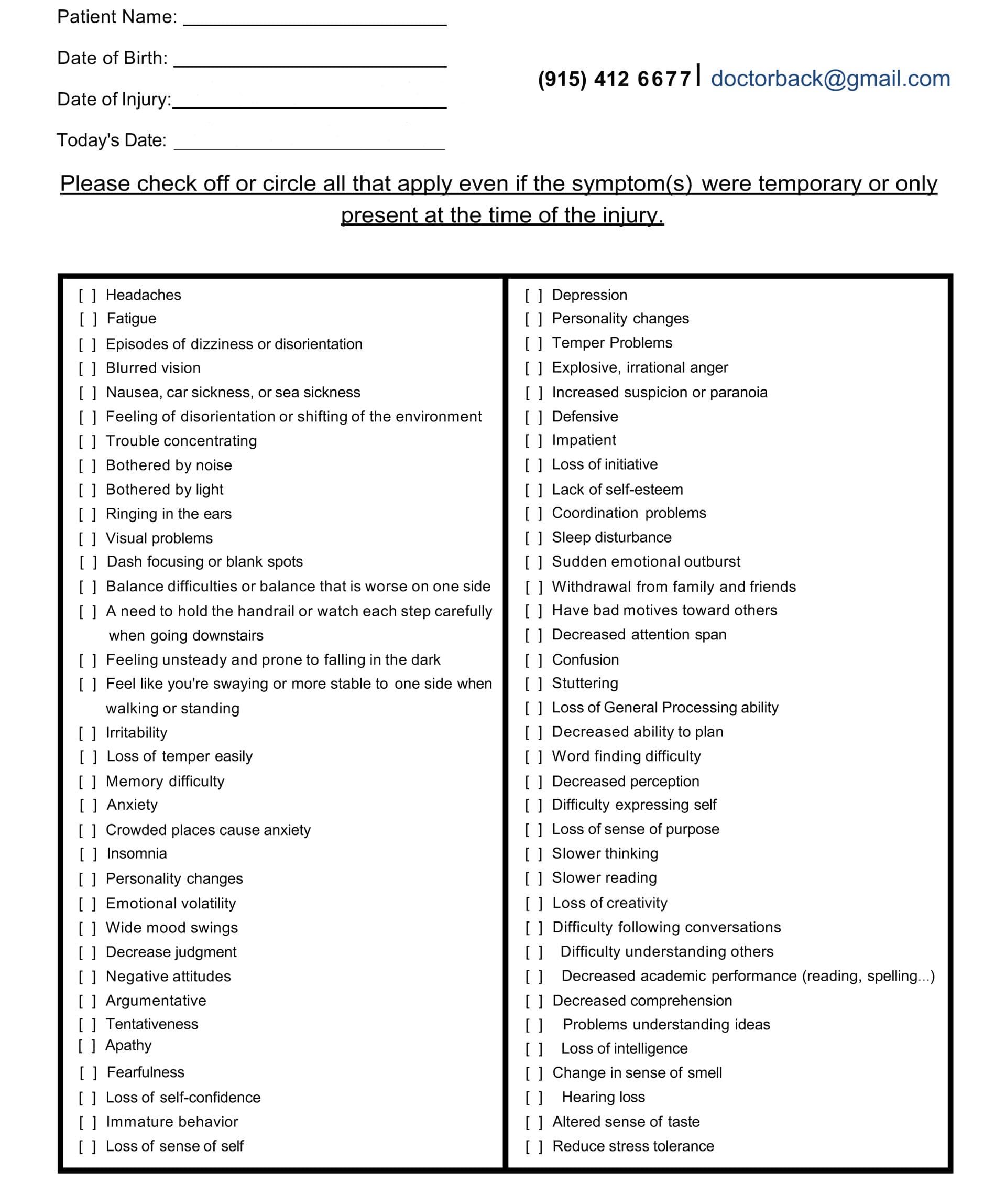
If you or someone close to you suspects a hidden TBI, bring a short checklist to your appointment and mark what applies:
-
Thinking/Attention – difficulty focusing, slower processing, memory slips (BrainLine, n.d.). BrainLine
-
Mood/Behavior – irritability, anxiety, depression, mood swings (Hanscom AFB, 2017). Hanscom Air Force Base
-
Headache Pattern – frequent, severe, or different from your usual headaches (Mayo Clinic, n.d.). Mayo Clinic
-
Sleep – trouble falling or staying asleep, oversleeping, or reversed sleep schedule (BrainLine, n.d.). BrainLine
-
Fatigue – low energy that doesn’t improve with rest (Mayo Clinic, n.d.). Mayo Clinic
-
Sensory Changes – light/noise sensitivity; blurry vision; tinnitus; taste or smell changes (Fisher Stark, 2021). Fisher Stark P.A.
-
Balance/Coordination – dizziness, unsteadiness, or poor coordination (Mayo Clinic, n.d.). Mayo Clinic
These signs are common after a concussion and often respond best to a plan that addresses both the nervous and musculoskeletal systems, while also supporting sleep, mood, and metabolic health (BrainLine, n.d.; Mayo Clinic, n.d.). BrainLine+1
When to Seek Urgent Care
Go to urgent care or the ER if you have “red flag” symptoms like a severe or worsening headache, repeated vomiting, seizures, weakness or numbness, slurred speech, confusion that is getting worse, or unequal pupils. These may indicate a more serious injury that needs immediate medical evaluation (Mayo Clinic, n.d.). Mayo Clinic
Why an Integrative Team Helps TBI Patients Recover
Recovery improves when we treat the whole person. An integrative approach pairs chiropractic care—focused on the spine, joints, and nervous system—with medical supervision by a nurse practitioner who coordinates workups, monitors mental health, and manages sleep, pain, and metabolic needs. This model reflects how many rehabilitation teams now operate: multiple professionals combining their strengths for better outcomes (Vining et al., 2018; Riva et al., 2010). PMC+1
Chiropractors commonly support patients with whiplash-associated disorders and post-concussion complaints—neck pain, headaches, stiffness, and sensory sensitivity—within a broader rehabilitation program (Northwestern Health Sciences University, 2022). Northwestern Health Sciences University
Nurse practitioners play a central role in preventing secondary injury (for example, uncontrolled blood pressure, low oxygen, or fever), guiding sleep and activity pacing, educating families, and coordinating referrals for counseling, vestibular therapy, or imaging when needed (Jang et al., 2024). MDPI
How Chiropractic Care Fits: Protecting Nerves, Restoring Motion, and Supporting the Brain
Why the spine matters in TBI: The spine houses the spinal cord—the main highway between brain and body. Misalignment or soft-tissue restriction in the neck and upper back can worsen headaches, brain fog, and balance problems by disturbing normal nerve signaling (Northwest Florida Physicians Group, 2025). northwestfloridaphysiciansgroup.com
What adjustments may do: Research suggests spinal adjustments can influence how the brain processes sensory and pain signals and may alter neural activity patterns—early evidence of brain–body communication changes during care (Haavik, 2024; Jimenez, n.d.). MDPI+1
Soft-tissue therapy: Gentle muscle and fascia work in the neck and shoulders can reduce trigger points and improve mobility, which often helps headaches and postural strain after concussion (Apex Chiropractic, n.d.; Pinnacle Health Chiropractic, n.d.). Apex Chiropractic+1
Specific exercises: Many patients benefit from guided cervical stabilization, ocular/vestibular drills (for gaze stability and balance), and graded aerobic activity. These build tolerance gently and help the brain reorganize signals after injury while reducing neck-driven triggers (Mayo Clinic, n.d.; BrainLine, n.d.). Mayo Clinic+1
Safety first: Chiropractic care for TBI should be individualized, progress-based, and part of a team plan. Screening for red flags and using appropriate referrals are essential. Collaborative rehab settings that include a chiropractor report that coordinated goals, communication, and timing (“different times for different people”) support safer, more effective care (Chiropractic & Manual Therapies, 2018). BioMed Central
What the Nurse Practitioner Oversees: Medical, Mental, and Metabolic Health
An NP’s lens is broad. In TBI care, common priorities include:
-
Sleep restoration: Sleep drives brain recovery. NPs help establish sleep–wake routines, adjust light exposure timing, and assess for sleep apnea or insomnia if recovery stalls.
-
Headache management: From non-drug strategies to medication when needed, NPs help organize stepwise plans and watch for medication-overuse headaches.
-
Mood and cognition: Screening for anxiety, depression, and attention problems is standard. If needed, NPs connect patients to counseling and use Collaborative Care models that embed behavioral health into primary care to improve access and outcomes (Reist et al., 2022). PMC
-
Blood pressure, oxygenation, and temperature: Preventing secondary brain stress is a nursing priority in the early and subacute phases (Jang et al., 2024). MDPI
-
Nutrition and inflammation: NPs often coordinate anti-inflammatory nutrition, hydration, and gut health support, which can influence symptoms such as fatigue and mood changes (Jimenez, n.d.). El Paso, TX Doctor Of Chiropractic
A Step-by-Step: What a Combined Chiropractic + NP Visit Can Look Like
1) Intake and history. You’ll describe the injury, your current symptoms, and what triggers them. Expect many follow-up questions—this is the heart of finding hidden issues. Standardized tools (for headache, mood, sleep, and balance) may be used to capture a baseline (Mayo Clinic, n.d.; BrainLine, n.d.). Mayo Clinic+1
2) Neuro-musculoskeletal exam. Posture, neck range of motion, joint palpation, muscle tone, cranial nerve screening, eye movements, balance tests, and simple cognitive screens help locate the main pain generators and neurosensory sensitivities. This shows how the neck and spine may contribute to brain symptoms (Northwest Florida Physicians Group, 2025; Denver Chiropractic, n.d.). northwestfloridaphysiciansgroup.com+1
3) Safety screen. Red flags trigger urgent imaging or referral. Your NP weighs medical risks and coordinates tests as needed (Mayo Clinic, n.d.). Mayo Clinic
4) Early care plan.
-
Chiropractic: gentle, progressive joint work (mobilization or adjustments as appropriate), soft-tissue therapy, and posture strategies.
-
Exercises: cervical stabilization, breathing practice, and graded vestibular/ocular drills to reduce dizziness and improve gaze control.
-
Medical support: sleep schedule, hydration, headache management, and mood support; family education and pacing of work or school tasks (Jang et al., 2024; Haavik, 2024). MDPI+1
5) Ongoing communication. Integrative teams meet or message regularly to adjust the plan. Studies of collaborative rehab highlight that adding a chiropractor to the team can be a good fit when goals are aligned and communication is clear (Vining et al., 2018; Riva et al., 2010). PMC+1
What Progress Often Looks Like Over Weeks
Every brain heals at its own pace. With consistent care:
-
Headaches may reduce in frequency and intensity as neck mechanics improve and sleep normalizes (Apex Chiropractic, n.d.; Pinnacle Health Chiropractic, n.d.). Apex Chiropractic+1
-
Dizziness and balance often improve with vestibular drills and cervical stabilization.
-
Cognitive load tolerance (screen time, reading, multi-tasking) slowly increases with pacing and routine rest breaks.
-
Mood steadies as symptoms ease and lifestyle anchors (sleep, light meals, movement) take hold.
-
Exercise tolerance increases with graded activity; many patients return to daily life first, then to sports or heavy labor as milestones are met (Mayo Clinic, n.d.). Mayo Clinic
Dr. Alexander Jimenez’s Clinical Observations on Dual-Scope Care
Dr. Alexander Jimenez, DC, APRN, FNP-BC, emphasizes that dual-scope practice—chiropractic plus nurse practitioner training—lets a clinic connect the dots between spine mechanics, nerve signaling, brain function, and whole-person health. His educational articles and posts discuss how adjustments can influence brain activity and how anti-inflammatory strategies support post-concussion recovery. He also highlights the need for advanced imaging and coordinated referrals when red flags appear (Jimenez, n.d., site/LinkedIn). LinkedIn+3El Paso, TX Doctor Of Chiropractic+3El Paso, TX Doctor Of Chiropractic+3
Why Collaboration Matters (and Works)
Research and real-world rehab programs show that a multidisciplinary model—including chiropractic, medical/nursing, physical therapy, and behavioral health—helps patients recover more completely. Qualitative studies note the importance of timing, communication, and shared goals when adding a chiropractor to the team, while inpatient reports show chiropractic care integrating with neurorehabilitation for brain injury and stroke (Chiropractic & Manual Therapies, 2018; Vining et al., 2018). BioMed Central+1
On the medical side, nursing scoping reviews detail structured protocols to prevent secondary injury, educate families, and coordinate care. In parallel, behavioral health Collaborative Care models improve access to mental health support—key for patients struggling with irritability, anxiety, or depression after TBI (Jang et al., 2024; Reist et al., 2022). MDPI+1
At-Home Strategies That Reinforce Clinic Gains
Note: Always clear any home program with your clinician.
-
Sleep routine: Same bedtime and wake time daily; dim lights and reduce screens 60–90 minutes before bed.
-
Pacing: Use timers for work/study blocks; insert short breaks before symptoms spike.
-
Light aerobic activity: Walks or stationary cycling at an easy pace, building gradually if you’re symptom-stable.
-
Neck care: Gentle mobility and posture resets as taught by your chiropractor or therapist.
-
Fuel and hydration: Small, regular meals with protein, colorful plants, and adequate water to stabilize energy and mood (Jimenez, n.d.). El Paso, TX Doctor Of Chiropractic
-
Triggers list: Note lights, noise, or screens that worsen symptoms and plan around them while you heal.
Putting It All Together
Hidden TBI symptoms are real. They often present as subtle cognitive, emotional, and sensory changes, as well as headaches, fatigue, sleep issues, and balance problems that can lag behind the original event. A chiropractor or nurse practitioner can uncover these patterns by asking many questions and building a detailed history. An integrative plan—spinal adjustments, soft-tissue therapies, and targeted exercises, guided alongside NP-led medical, mental, and metabolic support—addresses both the hardware (spine and joints) and the software (brain and nervous system). When providers collaborate, patients have a clearer path to recovery and a safer, steadier return to work, school, sports, and life (Mayo Clinic, n.d.; BrainLine, n.d.; Vining et al., 2018; Jang et al., 2024). MDPI+3Mayo Clinic+3BrainLine+3
References
-
BrainLine. (n.d.). Symptoms of traumatic brain injury (TBI). BrainLine
-
Fisher Stark, P.A. (2021, Jan 23). Hidden signs of a serious head injury (traumatic brain injury symptoms). Fisher Stark P.A.
-
Hanscom Air Force Base. (2017, Mar 22). TBI recognition critical to treating invisible wounds. Hanscom Air Force Base
-
Haavik, H. (2024). Neuroplastic responses to chiropractic care. Brains. MDPI
-
Jang, H., et al. (2024). Nursing interventions to prevent secondary injury in critically ill patients with traumatic brain injury: A scoping review. Journal of Clinical Medicine, 13(8), 2396. MDPI
-
Mayo Clinic. (n.d.). Traumatic brain injury — Symptoms & causes. Mayo Clinic
-
Northwestern Health Sciences University. (2022). [Chiropractic and traumatic brain injuries]. In Chiropractic Economics. [News post]. Link. Northwestern Health Sciences University
-
Northwest Florida Physicians Group, LLC. (2025, Aug 4). Using chiropractic care to treat traumatic brain injuries. northwestfloridaphysiciansgroup.com
-
Pinnacle Health Chiropractic. (n.d.). Six ways chiropractic care supports healing after TBI. Pinnacle Health Chiropractic
-
Riva, J. J., et al. (2010). Chiropractors and collaborative care: An overview illustrated with a case report. The Journal of the Canadian Chiropractic Association, 54(3), 133–144. PMC
-
Vining, R. D., et al. (2018). Patients receiving chiropractic care in a neurorehabilitation hospital: A descriptive study. Journal of Evidence-Informed Practice. PMC
-
Apex Chiropractic. (n.d.). 3 benefits of chiropractic care following a traumatic brain injury. Apex Chiropractic
-
Denver Chiropractic, LLC. (n.d.). Mild traumatic brain injury: Can a chiropractor help?. Denver Integrated Spine Center
-
Jimenez, A. (n.d.). What to do after a concussion: An anti-inflammatory nutritional approach. El Paso, TX Doctor Of Chiropractic
-
Jimenez, A. (n.d.). Chiropractic subluxation: A comprehensive guide to neurophysiological and biomechanical impacts. El Paso, TX Doctor Of Chiropractic
-
Jimenez, A. (n.d.). A subluxated spine & a chiropractic adjustment changes brain function. El Paso, TX Doctor Of Chiropractic
-
Jimenez, A. (n.d.). Dr. Alexander Jimenez — LinkedIn. LinkedIn
Post Disclaimer
General Disclaimer, Licenses and Board Certifications *
Professional Scope of Practice *
The information herein on "Finding Hidden TBI Symptoms: Signs You Might Miss" is not intended to replace a one-on-one relationship with a qualified health care professional or licensed physician and is not medical advice. We encourage you to make healthcare decisions based on your research and partnership with a qualified healthcare professional.
Blog Information & Scope Discussions
Welcome to El Paso's Premier Wellness and Injury Care Clinic & Wellness Blog, where Dr. Alex Jimenez, DC, FNP-C, a Multi-State board-certified Family Practice Nurse Practitioner (FNP-BC) and Chiropractor (DC), presents insights on how our multidisciplinary team is dedicated to holistic healing and personalized care. Our practice aligns with evidence-based treatment protocols inspired by integrative medicine principles, similar to those on this site and on our family practice-based chiromed.com site, focusing on naturally restoring health for patients of all ages.
Our areas of multidisciplinary practice include Wellness & Nutrition, Chronic Pain, Personal Injury, Auto Accident Care, Work Injuries, Back Injury, Low Back Pain, Neck Pain, Migraine Headaches, Sports Injuries, Severe Sciatica, Scoliosis, Complex Herniated Discs, Fibromyalgia, Chronic Pain, Complex Injuries, Stress Management, Functional Medicine Treatments, and in-scope care protocols.
Our information scope is multidisciplinary, focusing on musculoskeletal and physical medicine; wellness; contributing etiological viscerosomatic disturbances within clinical presentations; associated somato-visceral reflex clinical dynamics; subluxation complexes; sensitive health issues; and functional medicine articles, topics, and discussions.
We provide and present clinical collaboration with specialists from various disciplines. Each specialist follows their professional scope of practice and licensure jurisdiction. We use functional health & wellness protocols to treat and support care for musculoskeletal injuries or disorders.
Our videos, posts, topics, and insights address clinical matters and issues that directly or indirectly relate to our clinical scope of practice.
Our office has made a reasonable effort to provide supportive citations and has identified relevant research studies that support our posts. We provide copies of supporting research studies upon request to regulatory boards and the public.
For further discussion on how this information relates to specific care plans or treatment protocols, please ask Dr. Alex Jimenez, DC, APRN, FNP-BC, or contact us at 915-850-0900.
We are here to help you and your family.
Blessings
Dr. Alex Jimenez DC, MSACP, APRN, FNP-BC*, CCST, IFMCP, CFMP, ATN
Email: [email protected]
Multidisciplinary Licensing & Board Certifications:
Licensed as a Doctor of Chiropractic (DC) in Texas & New Mexico*
Chiropractic Licenses:
Texas DC License #: TX5807, Verified: TX5807
New Mexico DC License #: NM-DC2182, Verified: NM-DC2182
Nurse Practitioner Licenses:
Texas APRN License #: 1191402, Verified: 1191402 *
New Mexico CNP License #: 90560, Verified 90560
Florida APRN License #: 11043890, Verified: APRN11043890 *
Colorado License #: C-APN.0105610-C-NP, Verified: C-APN.0105610-C-NP
New York License #: N25929, Verified N25929
Georgia APRN License #: GAA-NP005701
Multi-State Advanced Practice Registered Nurse (APRN*) Texas & Multi-States
Multi-state Compact APRN License by Endorsement (43 States)
Compact Status: Multi-State License: Authorized to Practice in 43 States*
Nursing Licensure Compact: Updated Here
DEA Registration: (Drug Enforcement Agency Registered)
All medical (MDs) and family practice providers (FNP-APRN) are registered and licensed to offer various levels of medication.
Verify Providers' DEA Registration Here
License Verification Link: Nursys License Verifier
* Prescriptive Authority Authorized (DEA Registered Providers). Call if Required
Board Certification:
ANCC FNP-BC: Board Certified Nurse Practitioner*
Education:
Graduate with Honors: ICHS: MSN-FNP (Family Nurse Practitioner Program)
Degree Granted. Master's in Family Practice, MSN Diploma (Cum Laude)
Dr. Alex Jimenez, DC, APRN, FNP-BC*, CFMP, IFMCP, ATN, CCST
(Board Certified: Family Practice Nurse Practitioner—Multistate)*
(Licensed Nurse Practitioner & Chiropractor - Multistate)*
Clinical Director
DC & FNP License (Review Above)
Digital Business Card
NPI: 1205907805
Dr. Maria Cardenas, MD
(Board Certified: Internal Medicine)
(Licensed Medical Doctor)
Medical Director, Clinical Director & Collaborative Physician
NPI # 1164426748
MD License #: J2933
Licenses and Board Certifications:
MD: Medical Doctor
DC: Doctor of Chiropractic
APRNP: Advanced Practice Registered Nurse
FNP-BC: Family Practice Specialization (Multi-State Board Certified)
FNP-BC: Family Practice Across Life Span (Neonatal to Geriatrics)
RN: Registered Nurse (Multi-State Compact License)
CFMP: Certified Functional Medicine Provider
MSN-FNP: Master of Science in Family Practice Medicine
MSACP: Master of Science in Advanced Clinical Practice
IFMCP: Institute of Functional Medicine
CCST: Certified Chiropractic Spinal Trauma
ATN: Advanced Translational Neutrogenomics
Family with Primary Care Focus (Family Nurse Practitioner or FNP)
- The Family Nurse Practitioner (FNP) promotes, maintains, and restores health for individuals and families across the lifespan. FNPs also identify health risks, promote wellness, and diagnose and manage acute and chronic illness.
- The FNP focuses on comprehensive primary care, promoting healthy lifestyles for patients across the lifespan in settings such as private practice, physician offices, and community health centers.
Memberships & Associations:
TCA: Texas Chiropractic Association: Member ID: 104311
TNA: Texas Nurse Association: Member ID: 06458222
TNP: Texas Nurse Practitioner Association ID: 2025091511
AANP: American Association of Nurse Practitioners: Member ID: 2198960
ANA: American Nurses Association: Member ID: 06458222 (District TX01)
| Primary Taxonomy | Selected Taxonomy | State | License Number |
|---|---|---|---|
| No | 111N00000X - Chiropractor | NM | DC2182 |
| Yes | 111N00000X - Chiropractor | TX | DC5807 |
| Yes | 363LF0000X - Nurse Practitioner - Family | TX | 1191402 |
| Yes | 363LF0000X - Nurse Practitioner - Family | FL | 11043890 |
| Yes | 363LF0000X - Nurse Practitioner - Family | CO | C-APN.0105610-C-NP |
| Yes | 363LF0000X - Nurse Practitioner - Family | NY | N25929 |
| Yes | 363LF0000X - Nurse Practitioner - Family | NM |
90560 |
| Yes | 363LF0000X - Nurse Practitioner - Family | GA | GAA-NP005701 |
Dr. Alex Jimenez, DC, APRN, FNP-BC*, CFMP, IFMCP, ATN, CCST
(Board Certified: Family Practice Nurse Practitioner—Multistate)*
(Primary Care Across Lifespan—Neonatal / Pediatric / Adult / Geriatrics)
(Licensed Nurse Practitioner & Chiropractor - Multistate)*
Clinical Director
Digital Business Card
NPI: 1205907805
Dr. Maria Cardenas, MD
(Board Certified: Internal Medicine)*
(Licensed Medical Doctor)*
Medical Director, Clinical Director & Collaborative Physician
NPI # 1164426748
MD License #: J2933
📆 Schedule Appointment: Schedule 24/7 (Click Here)