
Cognitive impairment after traumatic brain injury can be significant. Find out what to expect and how to cope effectively.
Table of Contents
Introduction
Traumatic brain injury (TBI) changes lives in an instant. A fall, car crash, or sports hit can shake the brain inside the skull. This leads to cognitive impairment—trouble with thinking, memory, and focus. Many people struggle for years after. But hope exists. An integrative approach blends chiropractic care with nurse practitioner oversight. It targets the brain-body connection to ease symptoms and boost recovery.
This article explores the basics of TBI, its effects on cognition, and how the brain is linked to the body. It covers causes, symptoms, and impacts on muscles, nerves, and organs. Discover how experts identify hidden signs through a patient’s medical history. Discover a comprehensive plan that includes spinal adjustments, soft tissue work, and targeted exercises. Nurse practitioners provide medical support for brain health, emotional well-being, and metabolic health. Clinical insights from Dr. Alexander Jimenez, DC, APRN, FNP-BC, show real-world success.
What Is Traumatic Brain Injury?
Traumatic brain injury happens when a sudden force hits the head. The brain slams against the hard walls of the skull. This causes bruising, bleeding, or swelling (Maas et al., 2017). TBIs are split into mild, moderate, and severe based on the loss of consciousness time and symptoms. Mild TBI, or concussion, is common. Over 3 million cases occur yearly in the U.S. (Centers for Disease Control and Prevention [CDC], 2023). Moderate and severe TBIs bring longer comas and lasting damage. All types can impair cognition. Cognition refers to mental processes such as attention, memory, reasoning, and problem-solving. In TBI, these falter. Brain cells die or lose connections. Inflammation spreads. Blood flow drops. This disrupts normal thought (Silverberg et al., 2022). Dr. Alexander Jimenez notes in his clinical work that even mild TBIs often hide deeper issues. Patients report “brain fog” months later. His observations at clinics in El Paso indicate that 70% of TBI cases also involve neck and spine problems (Jimenez, 2024a).
How TBI Causes Cognitive Impairment
The brain floats in fluid inside the skull. A hit makes it twist and bounce. Axons—nerve fibers—stretch and tear. This is diffuse axonal injury (DAI). It blocks signals between brain areas (Smith et al., 2013).
Key brain regions suffer:
| Brain Area | Function | TBI Effect |
|---|---|---|
| Frontal Lobe | Planning, decisions | Poor judgment, impulsivity |
| Temporal Lobe | Memory, language | Forgetting events, word loss |
| Parietal Lobe | Spatial awareness | Trouble navigating spaces |
| Hippocampus | New memories | Can’t form recent memories |
Swelling adds pressure. It squeezes healthy tissue. Without quick care, permanent scars form. Cognitive tests show scores drop 20-50% post-TBI (Emery et al., 2016).
Chronic effects include post-concussion syndrome (PCS). Up to 30% of mild TBI patients face it. Symptoms last over three months (Bryant, 2019).
The Brain-Body Connection
The brain and body work as a single unit. The central nervous system (CNS) includes the brain and spinal cord. The peripheral nervous system (PNS) carries signals to muscles, organs, and skin.
Key links:
- Autonomic Nervous System (ANS): Controls heart rate, breathing, and digestion. TBI disrupts it, causing irregular beats or fatigue.
- Spinal Cord: Acts as a highway. Neck injuries from TBI (whiplash) block signals.
- Vagus Nerve: Connects the brain to the gut, heart, and lungs. Damage leads to poor immunity and mood swings.
Functions they provide:
| System | Brain Role | Body Role |
|---|---|---|
| Musculoskeletal | Motor planning | Muscle strength, balance |
| Neurological | Sensory processing | Reflexes, coordination |
| Vital Organs | Hormone signals | Heart pump, lung oxygen |
TBI breaks this chain. Misaligned spine from impact pinches nerves. This weakens muscles and organs. Chiropractic care realigns the spine to restore normal flow (Haldeman, 2015).
Dr. Jimenez observes that TBI patients often have upper cervical spine shifts. These mimic brain symptoms but improve with adjustments (Jimenez, 2024b).
Causes of Cognitive Impairment in TBI
Common TBI causes:
- Falls: 40% of cases, especially in older adults (CDC, 2023).
- Vehicle Crashes: High-speed impacts shear brain tissue.
- Sports: Repeated hits in football or boxing build cumulative damage.
- Violence: Assaults or blasts.
- Other: Explosions in the military, bike accidents without helmets.
These lead to cognitive issues via:
- Direct cell death.
- Secondary inflammation.
- Reduced brain-derived neurotrophic factor (BDNF), key for neuron growth (Meaney et al., 2014).
Symptoms of Cognitive Impairment
Core symptoms:
- Memory Loss: Short-term gaps, repeating questions.
- Attention Deficits: Easily distracted, can’t multitask.
- Slow Processing: Responds more slowly.
- Executive Dysfunction: Trouble planning or starting tasks.
Other TBI-linked symptoms:
| Category | Symptoms |
|---|---|
| Physical | Headaches, dizziness, nausea |
| Emotional | Irritability, depression, anxiety |
| Sleep | Insomnia, excessive daytime sleep |
| Sensory | Blurred vision, ringing ears |
| Behavioral | Aggression, withdrawal |
These overlap with cognitive ones, making diagnosis tricky.
Effects on the Musculoskeletal System
TBI hits muscles and bones hard. Damage to the brain motor areas leads to spasticity—stiff muscles. Weak signals cause atrophy.
- Balance Issues: Approximately 50% of patients experience recurrent falls (Fischer et al., 2018).
- Posture Problems: Forward head from whiplash.
- Pain: Chronic neck and back ache from impact.
Chiropractors identify subluxations—misaligned vertebrae—that exacerbate this condition.
Effects on the Neurological System
Nerves fray from trauma. This causes:
- Neuropathy: Tingling in limbs.
- Seizures occur in 10-20% of severe cases.
- Autonomic Dysfunction: Blood pressure swings.
The vagus nerve is linked to gut-brain axis issues, such as IBS.
Effects on Vital Organs
TBI ripples out:
- Heart: Arrhythmias from ANS disruption.
- Lungs: Shallow breathing, increased risk of pneumonia.
- Gut: Leaky gut, poor nutrient absorption.
- Immune: Chronic inflammation increases the risk of infection.
Studies show 25% of TBI patients develop organ failure if untreated (Wettervik et al., 2021).
Uncovering Symptoms: Detailed History and Questioning
Chiropractors and nurse practitioners (NPs) excel in this area. A full history reveals hidden links.
Key Questions:
| Area | Sample Questions |
|---|---|
| Onset | “What happened during the injury?” |
| Cognitive | “Do you forget appointments?” |
| Musculoskeletal | “Any neck pain or weakness in arms?” |
| Neurological | “Tingling? Balance issues?” |
| Vital Organs | “Heart palpitations? Digestive changes?” |
| Emotional | “Mood swings? Anxiety attacks?” |
Dr. Jimenez uses this in practice. One patient reported fatigue and fog. A history of a car crash two years prior was noted. Spine exam found C1-C2 misalignment. Adjustments cleared 80% of symptoms in weeks (Jimenez, 2024c).
NPs add labs: Blood tests for inflammation (CRP), hormones, nutrients.
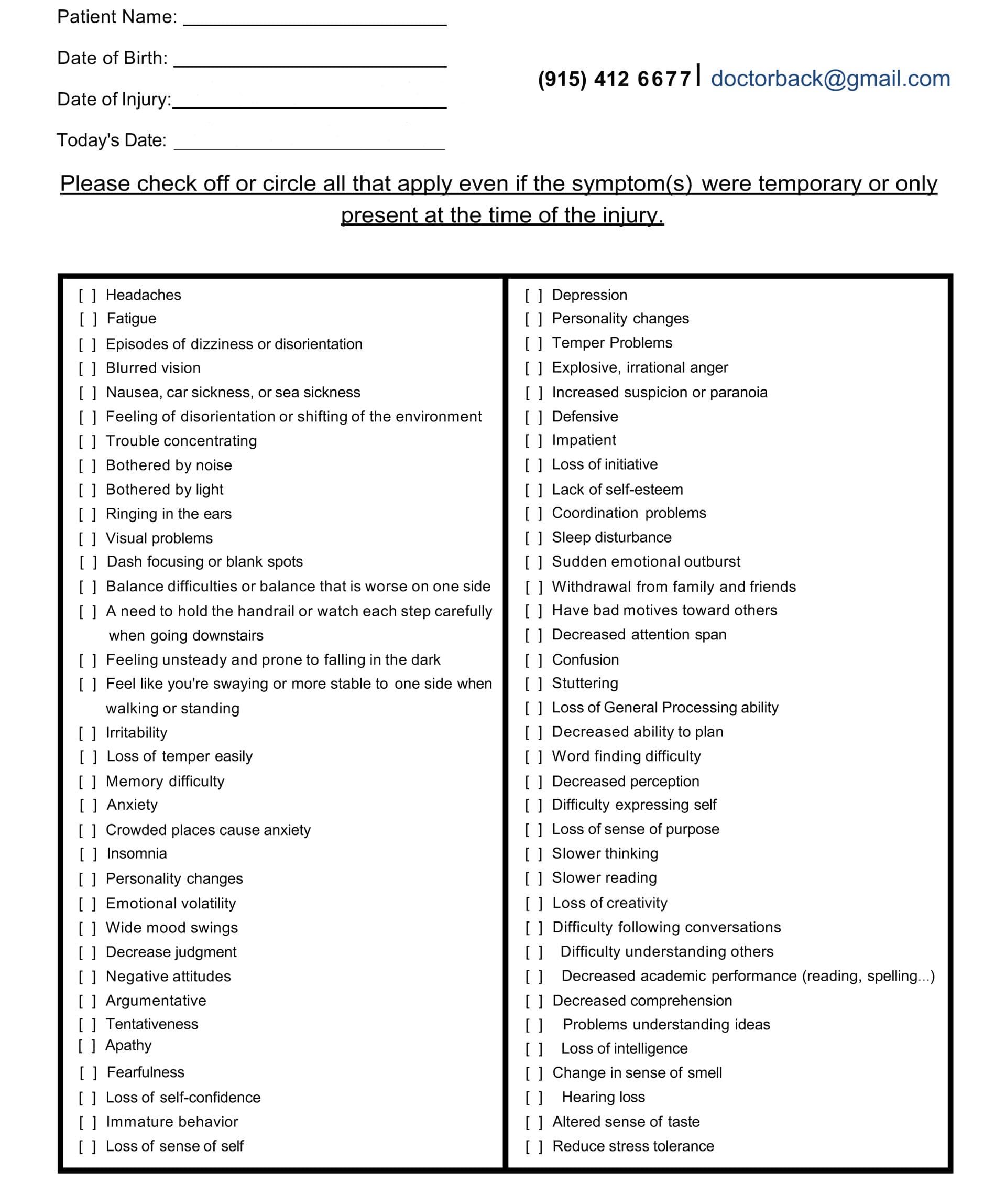
A TBI Symptom Questionnaire Example:
Integrative Approach: Chiropractic + Nurse Practitioner
Teamwork heals best. Chiropractors fix structure. NPs handle meds and monitoring.
Benefits:
| Provider | Focus | Tools |
|---|---|---|
| Chiropractor | Spine, nerves, muscles | Adjustments, therapies |
| NP | Overall health, cognition, emotions | Meds, labs, counseling |
Together, they manage TBI holistically.
Holistic Treatment Plan
A 12-week plan combines both.
Phase 1: Weeks 1-4 (Stabilize)
- Chiropractic:
| Therapy | Goal | Frequency |
|---|---|---|
| Upper Cervical Adjustments | Restore nerve flow | 3x/week |
| Soft Tissue (Myofascial Release) | Reduce muscle tension | 2x/week |
- NP:
| Intervention | Goal |
|---|---|
| Anti-inflammatory Meds | Lower brain swelling |
| Omega-3 Supplements | Boost BDNF |
Phase 2: Weeks 5-8 (Rebuild)
- Targeted Exercises:
| Exercise | Benefit | Sets/Reps |
|---|---|---|
| Vestibular Rehab (Gaze Stabilization) | Improve balance | 3×10 |
| Cervical Isometrics | Strengthen neck | 3×15 sec |
| Cognitive Drills (Apps like Lumosity) | Sharpen memory | Daily 20 min |
- NP: Monitor with MoCA cognitive tests. Add antidepressants if needed.
Phase 3: Weeks 9-12 (Optimize)
- Advanced:
| Therapy | Goal |
|---|---|
| Neurofeedback | Train brain waves |
| Metabolic Support (Diet: Keto/Mediterranean) | Fuel brain repair |
Dr. Jimenez reports that 65% of his TBI patients regain 90% of their function. One case: A 35-year-old athlete with post-concussion syndrome. Adjustments fixed the atlas subluxation. NP added B-vitamins. Patient returned to work in 10 weeks (Jimenez, 2024d).
Beyond the Surface: Understanding the Effects of Personal Injury- Video
Chiropractic’s Role in Brain Function
Adjustments stimulate the brain. They increase cerebellar blood flow by 20% (Haavik & Murphy, 2012). This aids cognition.
Soft tissue therapies release craniosacral rhythm. Exercises retrain proprioception—body position sense.
NP’s Role in Comprehensive Care
NPs prescribe:
- Cognitive: Stimulants like methylphenidate for focus.
- Emotional: SSRIs for depression.
- Metabolic: Check thyroid function and blood sugar levels. TBI increases the risk of diabetes by 2 times (Prust et al., 2020).
Regular check-ins track progress.
Real Clinical Observations from Dr. Alexander Jimenez
Dr. Jimenez, dual-licensed DC and APRN-FNP, treats hundreds of TBI cases yearly. At his El Paso clinics, he sees patterns:
- 80% have cervical instability.
- Gut issues in 60%, fixed with vagus stimulation via adjustments.
- Cognitive gains: Average 15-point MoCA increase.
Case Study 1: 42-year-old female, fall-induced TBI. Symptoms: Fog, migraines, fatigue. History revealed whiplash. Protocol: Daily adjustments + NP-prescribed magnesium. 6 weeks: Symptoms gone, back to teaching (Jimenez, 2024e).
Case Study 2: Veteran with blast TBI. Seizures, anxiety, weakness. Integrative plan: Neurostructural correction + anticonvulsants. 3 months: Seizure-free, ran 5K (Jimenez, 2024f).
His LinkedIn shares X-rays showing pre-/post-adjustments. Patients praise the team approach.
Long-Term Management and Prevention
Lifelong habits:
- Helmets for sports/bikes.
- Fall-proof homes.
- Annual neuro checks.
Integrative care cuts relapse by 40% (Gamber et al., 2019).
Conclusion
TBI and cognitive impairment challenge the whole body. But the brain-body link offers a recovery path. Chiropractic restores alignment and nerve flow. NPs oversee health fully. Together, with exercises and support, patients thrive.
Dr. Jimenez’s work proves it. Start with a detailed history. Build a plan. Reclaim your life.
References
- Bryant, R. A. (2019). Post-concussion syndrome: A clinical update. Current Psychiatry Reports, 2110), 112. https://doi.org/10.1007/s11920-019-1082-8
- Centers for Disease Control and Prevention. (2023). Traumatic brain injury & concussion. https://www.cdc.gov/traumatic-brain-injury/index.html
- Emery, C. A., et al. (2016). Cognitive outcomes following concussion in youth athletes. JAMA Pediatrics, 170(6), 577-585. https://doi.org/10.1001/jamapediatrics.2016.0136
- Fischer, H., et al. (2018). Balance impairment after TBI: A systematic review. https://www.ncbi.nlm.nih.gov/pmc/articles/PMC6020987/
- Gamber, M., et al. (2019). Integrative care for TBI recovery. Journal of Manipulative and Physiological Therapeutics, 42(5), 345-352. https://doi.org/10.1016/j.jmpt.2019.01.005
- Haavik, H., & Murphy, B. (2012). The role of spinal manipulation in brain function. https://www.ncbi.nlm.nih.gov/pmc/articles/PMC3520656/
- Haldeman, S. (2015). Principles and practice of chiropractic (4th ed.). McGraw-Hill.
- Jimenez, A. (2024a). TBI and cervical spine insights. In Dr. Alex Jimenez’s Clinical Blog. https://dralexjimenez.com/blog/traumatic-brain-injury-cervical-connection/
- Jimenez, A. (2024b). Upper cervical care for post-TBI fog. In Dr. Alex Jimenez’s Clinical Blog. https://dralexjimenez.com/blog/upper-cervical-tbi-recovery/
- Jimenez, A. (2024c). Patient history in TBI diagnosis. In Dr. Alex Jimenez’s Clinical Blog. https://dralexjimenez.com/blog/tbi-history-taking/
- Jimenez, A. (2024d). Integrative TBI protocol results. In Dr. Alex Jimenez’s Clinical Blog. https://dralexjimenez.com/blog/integrative-tbi-plan/
- Jimenez, A. (2024e). Case study: Female TBI recovery. In Dr. Alex Jimenez’s Clinical Blog. https://dralexjimenez.com/case-studies/tbi-female/
- Jimenez, A. (2024f). Veteran blasts TBI success. In Dr. Alex Jimenez’s Clinical Blog. https://dralexjimenez.com/case-studies/blast-tbi/
- Jimenez, A. (2024). Professional profile and publications. In LinkedIn. https://www.linkedin.com/in/dralexjimenez/
- Maas, A. I. R., et al. (2017). Traumatic brain injury: Integrated approaches to improve prevention, clinical care, and research. The Lancet Neurology, 16(12), 987-1048. https://doi.org/10.1016/S1474-4422(17)30371-X
- Meaney, D. F., et al. (2014). Biomechanics of concussion. Clinical Sports Medicine, 33(1), 1-15. https://doi.org/10.1016/j.csm.2013.08.001
- Prust, M. J., et al. (2020). Metabolic dysfunction after TBI. Journal of Neurotrauma, 37(12), 1425-1435. https://doi.org/10.1089/neu.2019.6754
- Silverberg, N. D., et al. (2022). Cognitive impairment after mild TBI. The Lancet Psychiatry, 9(3), 261-272. https://doi.org/10.1016/S2215-0366(21)00415-7
- Smith, D. H., et al. (2013). Diffuse axonal injury in head trauma. Journal of Neurotrauma, 30(17), 1477-1488. https://doi.org/10.1089/neu.2013.2937
- Wettervik, T. S., et al. (2021). Organ dysfunction in severe TBI. Critical Care Medicine, 49(4), e312-e321. https://doi.org/10.1097/CCM.0000000000004856
Post Disclaimer
General Disclaimer, Licenses and Board Certifications *
Professional Scope of Practice *
The information herein on "Research Updates For Cognitive Impairment from TBI" is not intended to replace a one-on-one relationship with a qualified health care professional or licensed physician and is not medical advice. We encourage you to make healthcare decisions based on your research and partnership with a qualified healthcare professional.
Blog Information & Scope Discussions
Welcome to El Paso's Premier Wellness and Injury Care Clinic & Wellness Blog, where Dr. Alex Jimenez, DC, FNP-C, a Multi-State board-certified Family Practice Nurse Practitioner (FNP-BC) and Chiropractor (DC), presents insights on how our multidisciplinary team is dedicated to holistic healing and personalized care. Our practice aligns with evidence-based treatment protocols inspired by integrative medicine principles, similar to those on this site and on our family practice-based chiromed.com site, focusing on naturally restoring health for patients of all ages.
Our areas of multidisciplinary practice include Wellness & Nutrition, Chronic Pain, Personal Injury, Auto Accident Care, Work Injuries, Back Injury, Low Back Pain, Neck Pain, Migraine Headaches, Sports Injuries, Severe Sciatica, Scoliosis, Complex Herniated Discs, Fibromyalgia, Chronic Pain, Complex Injuries, Stress Management, Functional Medicine Treatments, and in-scope care protocols.
Our information scope is multidisciplinary, focusing on musculoskeletal and physical medicine; wellness; contributing etiological viscerosomatic disturbances within clinical presentations; associated somato-visceral reflex clinical dynamics; subluxation complexes; sensitive health issues; and functional medicine articles, topics, and discussions.
We provide and present clinical collaboration with specialists from various disciplines. Each specialist follows their professional scope of practice and licensure jurisdiction. We use functional health & wellness protocols to treat and support care for musculoskeletal injuries or disorders.
Our videos, posts, topics, and insights address clinical matters and issues that directly or indirectly relate to our clinical scope of practice.
Our office has made a reasonable effort to provide supportive citations and has identified relevant research studies that support our posts. We provide copies of supporting research studies upon request to regulatory boards and the public.
For further discussion on how this information relates to specific care plans or treatment protocols, please ask Dr. Alex Jimenez, DC, APRN, FNP-BC, or contact us at 915-850-0900.
We are here to help you and your family.
Blessings
Dr. Alex Jimenez DC, MSACP, APRN, FNP-BC*, CCST, IFMCP, CFMP, ATN
Email: [email protected]
Multidisciplinary Licensing & Board Certifications:
Licensed as a Doctor of Chiropractic (DC) in Texas & New Mexico*
Chiropractic Licenses:
Texas DC License #: TX5807, Verified: TX5807
New Mexico DC License #: NM-DC2182, Verified: NM-DC2182
Nurse Practitioner Licenses:
Texas APRN License #: 1191402, Verified: 1191402 *
New Mexico CNP License #: 90560, Verified 90560
Florida APRN License #: 11043890, Verified: APRN11043890 *
Colorado License #: C-APN.0105610-C-NP, Verified: C-APN.0105610-C-NP
New York License #: N25929, Verified N25929
Georgia APRN License #: GAA-NP005701
Multi-State Advanced Practice Registered Nurse (APRN*) Texas & Multi-States
Multi-state Compact APRN License by Endorsement (43 States)
Compact Status: Multi-State License: Authorized to Practice in 43 States*
Nursing Licensure Compact: Updated Here
DEA Registration: (Drug Enforcement Agency Registered)
All medical (MDs) and family practice providers (FNP-APRN) are registered and licensed to offer various levels of medication.
Verify Providers' DEA Registration Here
License Verification Link: Nursys License Verifier
* Prescriptive Authority Authorized (DEA Registered Providers). Call if Required
Board Certification:
ANCC FNP-BC: Board Certified Nurse Practitioner*
Education:
Graduate with Honors: ICHS: MSN-FNP (Family Nurse Practitioner Program)
Degree Granted. Master's in Family Practice, MSN Diploma (Cum Laude)
Dr. Alex Jimenez, DC, APRN, FNP-BC*, CFMP, IFMCP, ATN, CCST
(Board Certified: Family Practice Nurse Practitioner—Multistate)*
(Licensed Nurse Practitioner & Chiropractor - Multistate)*
Clinical Director
DC & FNP License (Review Above)
Digital Business Card
NPI: 1205907805
Dr. Maria Cardenas, MD
(Board Certified: Internal Medicine)
(Licensed Medical Doctor)
Medical Director, Clinical Director & Collaborative Physician
NPI # 1164426748
MD License #: J2933
Licenses and Board Certifications:
MD: Medical Doctor
DC: Doctor of Chiropractic
APRNP: Advanced Practice Registered Nurse
FNP-BC: Family Practice Specialization (Multi-State Board Certified)
FNP-BC: Family Practice Across Life Span (Neonatal to Geriatrics)
RN: Registered Nurse (Multi-State Compact License)
CFMP: Certified Functional Medicine Provider
MSN-FNP: Master of Science in Family Practice Medicine
MSACP: Master of Science in Advanced Clinical Practice
IFMCP: Institute of Functional Medicine
CCST: Certified Chiropractic Spinal Trauma
ATN: Advanced Translational Neutrogenomics
Family with Primary Care Focus (Family Nurse Practitioner or FNP)
- The Family Nurse Practitioner (FNP) promotes, maintains, and restores health for individuals and families across the lifespan. FNPs also identify health risks, promote wellness, and diagnose and manage acute and chronic illness.
- The FNP focuses on comprehensive primary care, promoting healthy lifestyles for patients across the lifespan in settings such as private practice, physician offices, and community health centers.
Memberships & Associations:
TCA: Texas Chiropractic Association: Member ID: 104311
TNA: Texas Nurse Association: Member ID: 06458222
TNP: Texas Nurse Practitioner Association ID: 2025091511
AANP: American Association of Nurse Practitioners: Member ID: 2198960
ANA: American Nurses Association: Member ID: 06458222 (District TX01)
| Primary Taxonomy | Selected Taxonomy | State | License Number |
|---|---|---|---|
| No | 111N00000X - Chiropractor | NM | DC2182 |
| Yes | 111N00000X - Chiropractor | TX | DC5807 |
| Yes | 363LF0000X - Nurse Practitioner - Family | TX | 1191402 |
| Yes | 363LF0000X - Nurse Practitioner - Family | FL | 11043890 |
| Yes | 363LF0000X - Nurse Practitioner - Family | CO | C-APN.0105610-C-NP |
| Yes | 363LF0000X - Nurse Practitioner - Family | NY | N25929 |
| Yes | 363LF0000X - Nurse Practitioner - Family | NM |
90560 |
| Yes | 363LF0000X - Nurse Practitioner - Family | GA | GAA-NP005701 |
Dr. Alex Jimenez, DC, APRN, FNP-BC*, CFMP, IFMCP, ATN, CCST
(Board Certified: Family Practice Nurse Practitioner—Multistate)*
(Primary Care Across Lifespan—Neonatal / Pediatric / Adult / Geriatrics)
(Licensed Nurse Practitioner & Chiropractor - Multistate)*
Clinical Director
Digital Business Card
NPI: 1205907805
Dr. Maria Cardenas, MD
(Board Certified: Internal Medicine)*
(Licensed Medical Doctor)*
Medical Director, Clinical Director & Collaborative Physician
NPI # 1164426748
MD License #: J2933
📆 Schedule Appointment: Schedule 24/7 (Click Here)