
Explore the connection between somatovisceral disorders and head injuries. Understand their impact on overall health.
Table of Contents
Understanding Head Injuries and Their Impact on the Brain-Body Connection Through Somatovisceral Disorders
Head injuries can change how your body feels and works in ways that go beyond just bumps or bruises. Imagine a bump on the head leading to stomach troubles, ongoing fatigue, or even trouble focusing during everyday tasks. This happens because of the brain-body connection, in which signals from your brain affect your organs and muscles, and vice versa. When a head injury disrupts this link, it can trigger somatovisceral disorders—conditions where body pain or issues in muscles and skin influence your internal organs. In this article, we’ll explore what these disorders are, how they’re linked to head injuries, and how outside factors like stress or pollution can make things worse. We’ll also look at simple, non-surgical ways to help fix these problems, drawing on real clinical insights from experts like Dr. Alexander Jimenez.
This guide is built for anyone dealing with lingering effects from a head injury, whether from a sports hit, a car accident, or a fall. By understanding these connections, you can take steps to feel better without relying on pills or operations. Keywords like “somatovisceral disorders,” “head injury symptoms,” and “brain-body connection” highlight key ideas to help you find more support online.
What Are Somatovisceral Disorders?
Somatovisceral disorders involve miscommunication between your body’s outer parts—such as muscles, skin, and bones—and your inner organs, including your heart, gut, and lungs. The word “somato” means body or muscle-related, and “visceral” refers to the soft organs inside you. Normally, these systems work together smoothly through nerves that carry messages back and forth. But when something goes wrong, like irritation in your back muscles sending wrong signals to your stomach, it can cause pain, swelling, or other issues in places far from the original problem.
Think of it like a faulty wire in a house: a short in one room might make lights flicker in another. These disorders often present as unexplained pain or functions that don’t match the injury site. For example, tight neck muscles from poor posture might lead to digestive upset because nerves in the spine connect those areas. Research shows this occurs through somatovisceral reflexes, in which stress on the body triggers changes in organs (Jänig, 2016). Doctors use terms like somatic symptom disorder (SSD) when these issues involve ongoing worry about physical feelings, blending body signals with emotional stress (American Psychiatric Association, 2013).
In everyday life, somatovisceral disorders might feel like chest tightness during anxiety or gut cramps after a long day of tension. They affect millions, often overlapping with conditions like irritable bowel syndrome (IBS) or chronic fatigue. Understanding this helps explain why treating just the surface pain isn’t always enough—you need to fix the whole wiring.
Dr. Alexander Jimenez, a chiropractor with over 30 years in non-surgical care, sees this often in his practice. He notes that imbalances in the spine can send mixed signals to organs, leading to widespread discomfort. In his functional medicine approach, he focuses on root causes, such as structural shifts, to restore balance, as shared in his wellness podcasts and clinic resources (Jimenez, 2024a).
The Link Between Head Injuries and Somatovisceral Disorders
Head injuries, even mild ones like concussions, can shake up the brain-body connection in big ways. A mild traumatic brain injury (mTBI) happens when your head gets jolted, causing the brain to bounce inside the skull. This disrupts nerve pathways linking your brain to your body, leading to somatovisceral issues. Studies show people with mTBI are more likely to develop somatic symptoms and related disorders (SSRD), where body pains feel intense and persistent without a clear cause (Jobin et al., 2025).
Why does this happen? The brain controls the autonomic nervous system (ANS), which regulates functions like your heartbeat and digestion without you having to think about it. A head injury can irritate this system, creating reflexes that amplify signals. For instance, post-injury inflammation might make gut nerves overreact, causing nausea or bloating—classic somatovisceral signs. One review found links between mTBI and functional seizures or unexplained pains, suggesting the brain’s wiring gets crossed (Jobin et al., 2025).
Another study examined 476 adults after mTBI and found that 15-27% developed SSD six months later. These folks had more pain, fatigue, and emotional distress, with early beliefs about the injury’s severity predicting worse outcomes (Silverberg et al., 2025). It’s like the brain replays the trauma, sending stress signals to the body that linger.
In clinical settings, Dr. Jimenez observes this in patients post-accident. He describes cases where whiplash-like head trauma leads to gut issues or irregular heartbeats due to spine-brain miscommunication. His team uses gentle adjustments to calm these reflexes, helping patients regain control (Jimenez, 2024b). This correlation shows head injuries don’t just hurt the head—they ripple through the whole body.
How Head Injuries Disrupt the Brain-Body Connection
The brain-body connection relies on a web of nerves, hormones, and blood flow. Your central nervous system (CNS) includes the brain and spinal cord, while the somatic system handles voluntary moves like walking, and the autonomic system handles automatic ones like breathing. Head injuries mess this up by causing swelling or nerve damage, which can block clear signals.
After a concussion, the brain might swell slightly, pressing on pathways that link to the vagus nerve—a key player in calming the body. This can weaken vagal tone, the nerve’s ability to reduce stress, leading to faster heart rates or poor digestion. Somatovisceral disorders emerge when somatic (body) issues feed into visceral (organ) problems, like neck strain triggering stomach cramps via spinal reflexes (Burns, 1907, as cited in StatPearls, 2023).
Over time, this creates a loop: injury causes pain, pain stresses the brain, and stress worsens organ function. Dr. Jimenez points out in his neuropathy center work that head trauma often pairs with autonomic changes, like dizziness or sweating issues, from disrupted somatovisceral paths (Jimenez, 2024b). Fixing the connection means addressing both brain signals and body responses.
Understanding Long-Lasting Injuries- Video
Symptoms of Somatovisceral Disorders Linked to Head Injuries
After a head injury, many people expect headaches, dizziness, or maybe some memory fog. What surprises most is how the same injury can make the rest of the body feel “off” in ways that don’t seem connected to the head at all. These are somatovisceral symptoms—when the body’s outer structures (muscles, joints, skin) send confusing signals that mess up how organs work.
Here are the most common overlapping symptoms doctors see months and even years after concussions or whiplash-type injuries:
- Digestive problems that appear out of nowhere
Nausea, bloating, alternating constipation and diarrhea, or acid reflux can start right after a car accident or sports collision. The vagus nerve, which runs from the brainstem through the neck to the stomach and intestines, often gets irritated by swelling or neck misalignment. One large study found that 40–60% of people with lingering post-concussion symptoms also had irritable bowel syndrome (IBS)-like complaints that were not present before the injury (Stubbs et al., 2020). - Heart and breathing changes
Many patients feel their hearts racing or skipping beats for no reason. Some get short of breath just walking across a room. This happens because head trauma can lower vagal tone—the “brake pedal” of the nervous system—leaving the fight-or-flight system stuck in the “on” position (Silverberg et al., 2025). - Widespread pain and strange sensations
Burning, tingling, or electric-shock feelings in the arms, legs, or torso are common. Patients say, “It feels like my whole body is inflamed even though the doctors can’t find anything on regular tests.” These are classic signs of central sensitization, in which the brain amplifies pain signals after injury (Jobin et al., 2025). - Temperature and sweating problems
Some people sweat too much on one side of the body or not at all. Others feel cold hands and feet all the time. These autonomic changes come from disrupted brain-stem control of blood vessels and sweat glands. - Fatigue that sleep doesn’t fix
Even after 10–12 hours of sleep, people wake up exhausted. The brain is using extra energy to calm the mixed-up signals from the body, leaving nothing for daily activities. - Mood and thinking issues that feel physical
Anxiety, panic attacks, brain fog, and trouble finding words are not “just in your head.” They happen because the same nerve pathways that control mood also control gut and heart function. When those pathways are inflamed from a head injury, everything feels worse at once (Jobin et al., 2025).
Dr. Alexander Jimenez regularly sees patients who were told “it’s all anxiety” when they actually had measurable nerve irritation from old head or neck trauma. In his clinic, heart-rate variability testing often shows very low vagal tone in these patients—proof that the problem is physical, not imaginary (Jimenez, 2024b).
| Common Symptom | How It Feels Day-to-Day | Why It Happens After a Head Injury |
|---|---|---|
| Stomach pain / IBS | Constant bloating, cramps after eating | Vagus nerve irritation + inflammation |
| Racing heart | Heart pounds when standing or resting | Lost vagal brake on the heart |
| Burning skin/tingling | Feels like sunburn or pins-and-needles | Central sensitization in the brain |
| Extreme fatigue | “Dead battery” feeling all day | The brain is working overtime to fix signals |
| Temperature issues | Ice-cold hands or hot flashes | Autonomic centers in the brainstem are damaged |
Environmental Factors Influencing Brain Activity and the Body
Your surroundings play a huge role in how head injuries heal or worsen somatovisceral issues. Things like air pollution, noise, or even social stress can tweak brain waves and body responses. For instance, heavy metals from polluted water can cross the blood-brain barrier, triggering inflammation that increases nerve sensitivity (Xu et al., 2020).
Stress from work or traffic raises cortisol, a hormone that disrupts the gut-brain axis—the direct line between your belly and brain. This can turn mild post-injury gut feelings into full IBS, especially if reflexes are already off (Jimenez, 2022a). A poor diet or lack of sunlight can alter serotonin levels, which are mostly produced in the gut, affecting mood and pain thresholds.
These factors hit daily routines hard. Imagine trying to drive with pollution-fogged focus or cook dinner amid noise-induced anxiety—simple tasks become exhausting. In kids or elders, this increases the risk of emotional development issues or accelerated aging of brain cells (Faig et al., 2023).
Dr. Jimenez emphasizes environmental tweaks in his functional medicine webinars, like reducing toxin exposure to ease neuropathy symptoms post-injury. He sees cleaner air and balanced diets cut inflammation, improving brain-body talks (Jimenez, 2024b).
Overlapping Risk Profiles and Body-Wide Effects
Somatovisceral disorders from head injuries create shared risks across systems, like a domino effect. One profile might be inflammation: brain swelling triggers body-wide cytokines that hit joints and gut alike. Another is ANS dysregulation, where low vagal tone links heart issues to poor sleep (Silverberg et al., 2025).
These profiles overlap in symptoms like widespread pain or mood dips, raising the chances of depression or chronic fatigue. Women post-mTBI often face higher rates due to hormonal ties (Jobin et al., 2025). The body feels attacked from inside, with routines like exercising or socializing suffering.
Dr. Jimenez’s case series shows veterans with head trauma developing overlapping gut and nerve pains. His integrated care maps these profiles to prevent escalation (Jimenez, 2024b).
Non-Surgical Treatments to Boost Somatovisceral Function
The good news is that the brain and body are amazingly good at healing when given the right kind of help. None of the treatments below requires surgery or strong medications, yet research and clinical experience show they can dramatically improve the brain-body connection.
- Chiropractic Spinal Adjustments (especially upper neck)
Gentle adjustments to the top two bones in the neck (C1 and C2) have been shown to increase vagus nerve activity within minutes. A 2021 pilot study measured heart-rate variability before and after an upper-cervical adjustment and found a clear jump in parasympathetic (rest-and-digest) tone—the exact opposite of fight-or-flight (Goetz et al., 2021, as cited in Momentum Chiropractic, 2025). Dr. Jimenez uses precision instruments and low-force techniques so even people with fresh concussions can safely receive care (Jimenez, 2024a). You don’t need surgery to mend these issues—gentle, hands-on methods work well. Chiropractic care tops the list, using spinal adjustments to ease nerve pressure and reset reflexes. Studies back this for post-mTBI symptom relief (Hawk, 2016). - Cranial-Sacral Therapy and Myofascial Release
A light touch to the skull and spine helps calm swollen membranes around the brain and spinal cord. Patients often feel a wave of relaxation and better breathing right on the table. - Vagus Nerve Stimulation Exercises (no devices needed): These simple daily habits turn the vagus nerve back “on” and lower inflammation throughout the body.
- Slow, deep belly breathing (4 seconds in, 6–8 seconds out)
- Gargling hard until the eyes water
- Humming or singing loudly
- Cold showers or splashing cold water on the face
- Acupuncture
Needles placed along the ear (auricular acupuncture) or along the vagus pathway in the neck quickly reduce pain and nausea after a concussion. Veterans with blast-related head injuries showed major drops in headache and gut symptoms after 6–8 weeks of acupuncture (Jimenez, 2024b). - Anti-Inflammatory Nutrition & Gut Healing
Removing gluten, dairy, and processed sugar while adding omega-3 fish oil, turmeric, ginger, and bone broth calms the gut-brain axis. Many of Dr. Jimenez’s patients notice their brain fog and stomach pain improve within 2–4 weeks from diet changes alone. - Neurofeedback and Brain Training
Special computer programs teach the brain to make healthier wave patterns. After 20–40 sessions, many patients report sharper thinking, better sleep, and far less body pain. - Graded Exercise & Movement Therapy
Starting with simple walking or pool therapy and slowly building up prevents the nervous system from staying stuck in protective mode. Dr. Jimenez’s rehab team uses CrossFit-style functional movements once the neck is stable—patients say they finally feel “normal” again. - Red-Light / Low-Level Laser Therapy
Shining specific wavelengths of red and near-infrared light on the skull and neck reduces brain inflammation and speeds healing of nerve tissue. Clinics using this report experience faster recovery from post-concussion syndrome. - Mindfulness and Heart-Rate Variability (HRV) Biofeedback
Apps and small chest sensors teach people to raise their own vagal tone in minutes a day. Higher HRV scores are directly associated with lower pain and anxiety levels (Silverberg et al., 2025).
When these treatments are combined—exactly what functional-medicine and chiropractic neurology clinics do—the results add up fast. In Dr. Jimenez’s experience, most patients achieve 50–80% improvement in somatovisceral symptoms within 8–12 weeks when following a full brain-body program (Jimenez, 2024b).
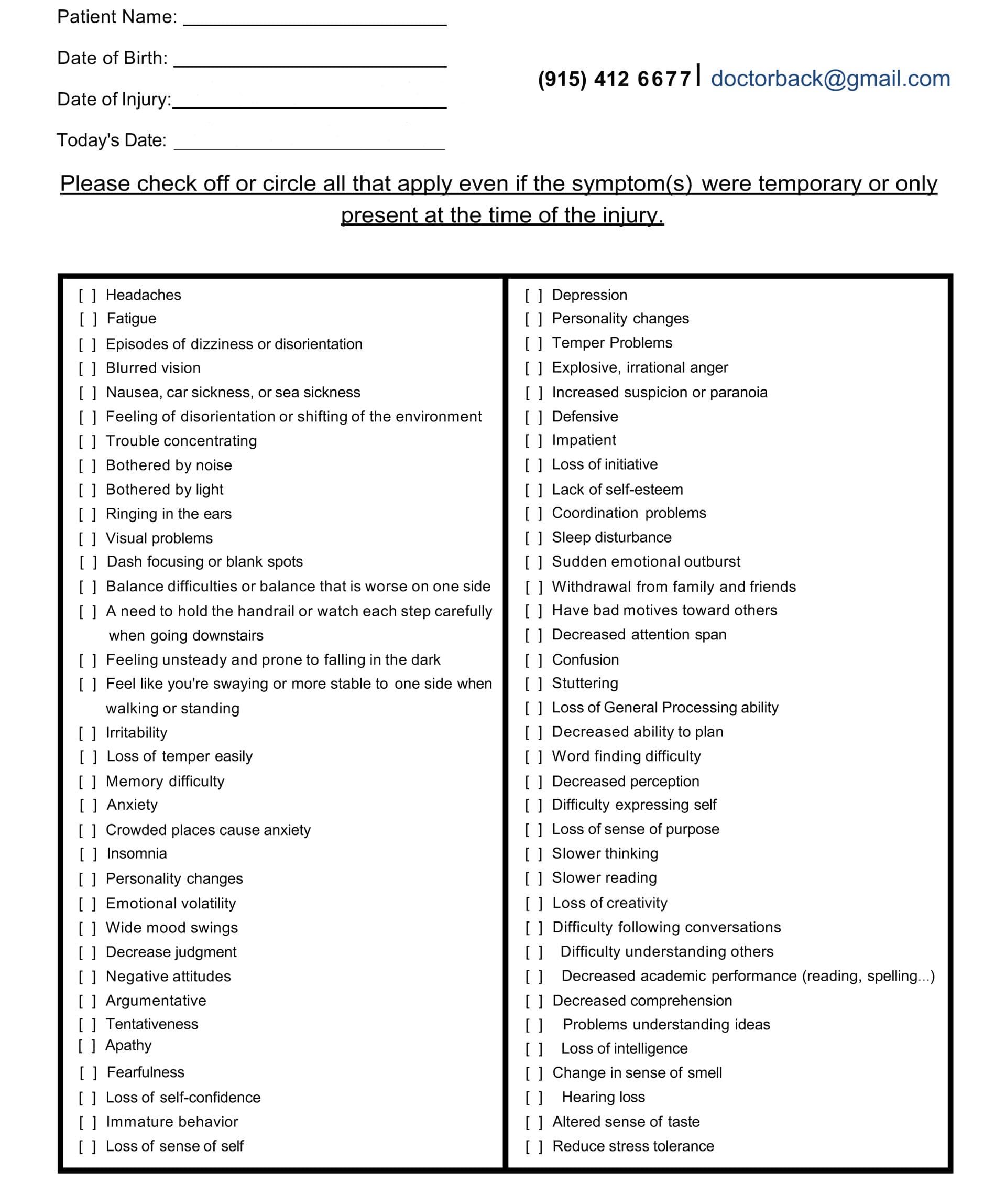
A Questionnaire Example of TBI Symptoms
 How Treatments Improve the Central Nervous System and Vagal Tone
These therapies rebuild the CNS by reducing noise in nerve lines. Adjustments improve blood flow to the brain, aiding repair (Masarsky & Todres-Masarsky, 2001). They boost vagal tone by stimulating the nerve through neck work, slowing heart rate, and easing digestion.
Better brain-body talk follows: somatic muscles relax, autonomic systems balance. This cuts symptoms like nausea or anxiety. Early research shows that chiropractic increases vagal activity, which is linked to reduced inflammation (Goetz et al., 2021, as cited in Momentum Chiropractic, 2025).
In Dr. Jimenez’s observations, patients with low vagal tone post-injury show improvements in heart rate variability after adjustments, enhancing overall calm (Jimenez, 2024a).
Enhancing Somatic and Autonomic Systems Through Better Communication
Restored communication means somatic (muscle) control pairs with autonomic (organ) harmony. Treatments like yoga build this by syncing breath with moves, strengthening vagus signals. Over time, you handle stress better, with fewer flare-ups.
Dr. Jimenez’s CrossFit rehab blends movement with adjustments, helping patients reclaim routines (Jimenez, 2024b). This holistic shift turns survival mode into thriving.
Conclusion: Reclaiming Your Brain-Body Balance
A head injury can feel like it breaks the invisible wires that keep your brain and body talking smoothly. The result—somatovisceral disorders—can turn simple daily tasks into exhausting battles. But the same nervous system that got disrupted is also built to heal.
Science and real-world clinics now prove that gentle, drug-free approaches—chiropractic care, vagus-nerve exercises, clean eating, acupuncture, and targeted movement—can turn the volume back down on pain, calm the gut, steady the heart, and clear the mind. Thousands of people who were told “you’ll just have to live with it” are now living active, comfortable lives again because they addressed the brain-body connection instead of masking symptoms.
If you or someone you love is still struggling weeks, months, or years after a head injury, know this: healing is possible. Start with the basics—deep breathing, gentle neck care, and cutting inflammatory foods—then work with a provider who understands somatovisceral reflexes and the vagus nerve. The body wants to heal; it just needs the right roadmap.
You don’t have to stay stuck. The brain-body connection that was damaged can become stronger than it was before.
References
- American Psychiatric Association. (2013). Diagnostic and statistical manual of mental disorders (5th ed.). https://doi.org/10.1176/appi.books.9780890425596
- Faig, K. E., Smith, K. E., & Dimitroff, S. J. (2023). Somatovisceral influences on emotional development. Emotion Review. https://doi.org/10.1177/17540739231163180
- Hawk, C. (2016). Chiropractic practice, experience, and research related to somatovisceral interactions. In Musculoskeletal Key. https://musculoskeletalkey.com/chiropractic-practice-experience-and-research-related-to-somatovisceral-interactions/
- Jänig, W. (2016). Basic science on somatovisceral interactions: Peripheral and central evidence-based implications for research. In Musculoskeletal Key. https://musculoskeletalkey.com/basic-science-on-somatovisceral-interactions-peripheral-and-central-evidence-base-and-implications-for-research/
- Jimenez, A. (2022a). The gut-brain axis is affected by somatovisceral pain. Dr. Alex Jimenez.com. https://dralexjimenez.com/gut-brain-axis-affected-somatovisceral-pain/
- Jimenez, A. (2022b). Weakness, pain, numbness, radiculopathy, and chiropractic. Chiropractic Scientist. https://chiropracticscientist.com/weakness-radiculopathy-chiro/
- Jimenez, A. (2024a). Injury specialists. Dr. Alex Jimenez.com. https://dralexjimenez.com/
- Jimenez, A. (2024b). Dr. Alexander Jimenez, DC, APRN, FNP-BC, IFMCP, CFMP, ATN ♛ – Injury Medical Clinic PA. LinkedIn. https://www.linkedin.com/in/dralexjimenez/
- Jobin, K., et al. (2025). Somatic symptom and related disorders and mild traumatic brain injury: A systematic review. Biopsychosoc Sci Med, 87(8), 548-564. https://doi.org/10.1097/PSY.0000000000001427
- Masarsky, C. S., & Todres-Masarsky, M. (2001). Somatovisceral aspects of chiropractic: An evidence-based approach. Churchill Livingstone. https://pmc.ncbi.nlm.nih.gov/articles/PMC2051312/
- Momentum Chiropractic. (2025). Chiropractor vagus nerve. Momentum Chiropractic Care. https://www.momentumchiropracticcare.com/blogs/news/chiropractor-vagus-nerve
- Silverberg, N. D., et al. (2025). Somatic symptom disorder after mild traumatic brain injury. Journal of Head Trauma Rehabilitation. https://doi.org/10.1097/HTR.0000000000001068
- StatPearls. (2023). Physiology, viscerosomatic reflexes. NCBI Bookshelf. https://www.ncbi.nlm.nih.gov/books/NBK559218/
- Stubbs, J. L., Green, K. E., Silverberg, N. D., Howard, A., Dhariwal, A. K., Brubacher, J. R., Garraway, N., Heran, M. K. S., Sekhon, M. S., Aquino, A., Purcell, V., Hutchison, J. S., Torres, I. J., & Panenka, W. J. (2020). Atypical Somatic Symptoms in Adults With Prolonged Recovery From Mild Traumatic Brain Injury. Frontiers in Neurology, 11, 43. https://pmc.ncbi.nlm.nih.gov/articles/PMC7010927/
- Xu, F., et al. (2020). Environmental pollutants and the risk of neurological disorders. Environmental Science and Pollution Research. https://doi.org/10.1007/s11356-020-11272-3
Post Disclaimer
General Disclaimer, Licenses and Board Certifications *
Professional Scope of Practice *
The information herein on "Somatovisceral Disorder Treatment Methods for Head Injuries" is not intended to replace a one-on-one relationship with a qualified health care professional or licensed physician and is not medical advice. We encourage you to make healthcare decisions based on your research and partnership with a qualified healthcare professional.
Blog Information & Scope Discussions
Welcome to El Paso's Premier Wellness and Injury Care Clinic & Wellness Blog, where Dr. Alex Jimenez, DC, FNP-C, a Multi-State board-certified Family Practice Nurse Practitioner (FNP-BC) and Chiropractor (DC), presents insights on how our multidisciplinary team is dedicated to holistic healing and personalized care. Our practice aligns with evidence-based treatment protocols inspired by integrative medicine principles, similar to those on this site and on our family practice-based chiromed.com site, focusing on naturally restoring health for patients of all ages.
Our areas of multidisciplinary practice include Wellness & Nutrition, Chronic Pain, Personal Injury, Auto Accident Care, Work Injuries, Back Injury, Low Back Pain, Neck Pain, Migraine Headaches, Sports Injuries, Severe Sciatica, Scoliosis, Complex Herniated Discs, Fibromyalgia, Chronic Pain, Complex Injuries, Stress Management, Functional Medicine Treatments, and in-scope care protocols.
Our information scope is multidisciplinary, focusing on musculoskeletal and physical medicine; wellness; contributing etiological viscerosomatic disturbances within clinical presentations; associated somato-visceral reflex clinical dynamics; subluxation complexes; sensitive health issues; and functional medicine articles, topics, and discussions.
We provide and present clinical collaboration with specialists from various disciplines. Each specialist follows their professional scope of practice and licensure jurisdiction. We use functional health & wellness protocols to treat and support care for musculoskeletal injuries or disorders.
Our videos, posts, topics, and insights address clinical matters and issues that directly or indirectly relate to our clinical scope of practice.
Our office has made a reasonable effort to provide supportive citations and has identified relevant research studies that support our posts. We provide copies of supporting research studies upon request to regulatory boards and the public.
For further discussion on how this information relates to specific care plans or treatment protocols, please ask Dr. Alex Jimenez, DC, APRN, FNP-BC, or contact us at 915-850-0900.
We are here to help you and your family.
Blessings
Dr. Alex Jimenez DC, MSACP, APRN, FNP-BC*, CCST, IFMCP, CFMP, ATN
Email: [email protected]
Multidisciplinary Licensing & Board Certifications:
Licensed as a Doctor of Chiropractic (DC) in Texas & New Mexico*
Chiropractic Licenses:
Texas DC License #: TX5807, Verified: TX5807
New Mexico DC License #: NM-DC2182, Verified: NM-DC2182
Nurse Practitioner Licenses:
Texas APRN License #: 1191402, Verified: 1191402 *
New Mexico CNP License #: 90560, Verified 90560
Florida APRN License #: 11043890, Verified: APRN11043890 *
Colorado License #: C-APN.0105610-C-NP, Verified: C-APN.0105610-C-NP
New York License #: N25929, Verified N25929
Georgia APRN License #: GAA-NP005701
Multi-State Advanced Practice Registered Nurse (APRN*) Texas & Multi-States
Multi-state Compact APRN License by Endorsement (43 States)
Compact Status: Multi-State License: Authorized to Practice in 43 States*
Nursing Licensure Compact: Updated Here
DEA Registration: (Drug Enforcement Agency Registered)
All medical (MDs) and family practice providers (FNP-APRN) are registered and licensed to offer various levels of medication.
Verify Providers' DEA Registration Here
License Verification Link: Nursys License Verifier
* Prescriptive Authority Authorized (DEA Registered Providers). Call if Required
Board Certification:
ANCC FNP-BC: Board Certified Nurse Practitioner*
Education:
Graduate with Honors: ICHS: MSN-FNP (Family Nurse Practitioner Program)
Degree Granted. Master's in Family Practice, MSN Diploma (Cum Laude)
Dr. Alex Jimenez, DC, APRN, FNP-BC*, CFMP, IFMCP, ATN, CCST
(Board Certified: Family Practice Nurse Practitioner—Multistate)*
(Licensed Nurse Practitioner & Chiropractor - Multistate)*
Clinical Director
DC & FNP License (Review Above)
Digital Business Card
NPI: 1205907805
Dr. Maria Cardenas, MD
(Board Certified: Internal Medicine)
(Licensed Medical Doctor)
Medical Director, Clinical Director & Collaborative Physician
NPI # 1164426748
MD License #: J2933
Licenses and Board Certifications:
MD: Medical Doctor
DC: Doctor of Chiropractic
APRNP: Advanced Practice Registered Nurse
FNP-BC: Family Practice Specialization (Multi-State Board Certified)
FNP-BC: Family Practice Across Life Span (Neonatal to Geriatrics)
RN: Registered Nurse (Multi-State Compact License)
CFMP: Certified Functional Medicine Provider
MSN-FNP: Master of Science in Family Practice Medicine
MSACP: Master of Science in Advanced Clinical Practice
IFMCP: Institute of Functional Medicine
CCST: Certified Chiropractic Spinal Trauma
ATN: Advanced Translational Neutrogenomics
Family with Primary Care Focus (Family Nurse Practitioner or FNP)
- The Family Nurse Practitioner (FNP) promotes, maintains, and restores health for individuals and families across the lifespan. FNPs also identify health risks, promote wellness, and diagnose and manage acute and chronic illness.
- The FNP focuses on comprehensive primary care, promoting healthy lifestyles for patients across the lifespan in settings such as private practice, physician offices, and community health centers.
Memberships & Associations:
TCA: Texas Chiropractic Association: Member ID: 104311
TNA: Texas Nurse Association: Member ID: 06458222
TNP: Texas Nurse Practitioner Association ID: 2025091511
AANP: American Association of Nurse Practitioners: Member ID: 2198960
ANA: American Nurses Association: Member ID: 06458222 (District TX01)
| Primary Taxonomy | Selected Taxonomy | State | License Number |
|---|---|---|---|
| No | 111N00000X - Chiropractor | NM | DC2182 |
| Yes | 111N00000X - Chiropractor | TX | DC5807 |
| Yes | 363LF0000X - Nurse Practitioner - Family | TX | 1191402 |
| Yes | 363LF0000X - Nurse Practitioner - Family | FL | 11043890 |
| Yes | 363LF0000X - Nurse Practitioner - Family | CO | C-APN.0105610-C-NP |
| Yes | 363LF0000X - Nurse Practitioner - Family | NY | N25929 |
| Yes | 363LF0000X - Nurse Practitioner - Family | NM |
90560 |
| Yes | 363LF0000X - Nurse Practitioner - Family | GA | GAA-NP005701 |
Dr. Alex Jimenez, DC, APRN, FNP-BC*, CFMP, IFMCP, ATN, CCST
(Board Certified: Family Practice Nurse Practitioner—Multistate)*
(Primary Care Across Lifespan—Neonatal / Pediatric / Adult / Geriatrics)
(Licensed Nurse Practitioner & Chiropractor - Multistate)*
Clinical Director
Digital Business Card
NPI: 1205907805
Dr. Maria Cardenas, MD
(Board Certified: Internal Medicine)*
(Licensed Medical Doctor)*
Medical Director, Clinical Director & Collaborative Physician
NPI # 1164426748
MD License #: J2933
📆 Schedule Appointment: Schedule 24/7 (Click Here)