

Table of Contents
Alcohol, Inflammation, and Cancer Risk: A Multidisciplinary Functional Medicine Approach
Abstract: Alcohol metabolism produces acetaldehyde, oxidative stress, gut-barrier disruption, and DNA damage—mechanisms that help explain alcohol-related cancer risk. New 2026 survey data show public awareness is improving, but confusion remains. Separately, the EMT2 trial offers an investigational supportive-nutrition example: prescription EPA improved five-year overall survival after colorectal liver-metastasis surgery without significantly changing progression-free survival. Together, they show why prevention and recovery require precise education, metabolic monitoring, nutrition, and multidisciplinary leadership.
Cancer risk can build through repeated exposures, inflammation, metabolic stress, and impaired DNA repair. Alcohol is a clear example because the body must process every drink. Root-cause care should identify modifiable contributors, reduce unnecessary exposure, and coordinate support with the patient’s medical team.
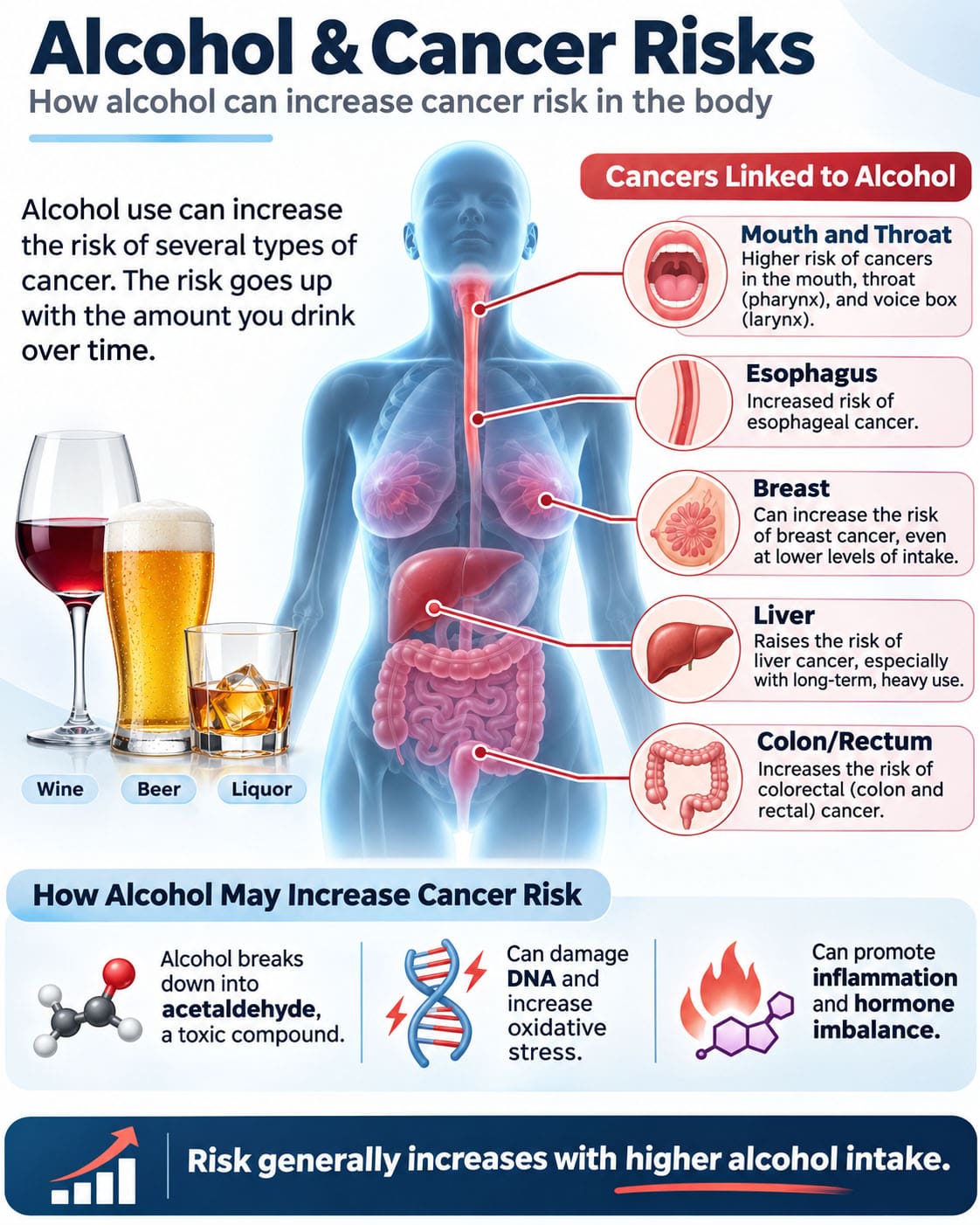 Alcohol Metabolism: From Ethanol to Acetaldehyde
Alcohol dehydrogenase converts ethanol into acetaldehyde. Aldehyde dehydrogenase then converts acetaldehyde into less-reactive acetate. The middle step matters because acetaldehyde is toxic and carcinogenic (National Institute on Alcohol Abuse and Alcoholism [NIAAA], n.d.).
The National Cancer Institute identifies acetaldehyde exposure, reactive oxygen species, impaired nutrient handling, hormonal effects, and interactions with tobacco carcinogens among mechanisms linking alcohol with cancer (National Cancer Institute [NCI], 2025). IARC recognizes causal associations between alcohol and cancers of the oral cavity, pharynx, larynx, esophagus, liver, colorectum, and female breast (International Agency for Research on Cancer [IARC], 2026).
Oxidative Stress, Glutathione, and DNA Damage
Alcohol metabolism can activate CYP2E1, especially with repeated or higher exposure. CYP2E1 generates reactive oxygen species that can oxidize lipids, proteins, and DNA while increasing mitochondrial stress and inflammatory signaling (Ceni et al., 2020).
Glutathione is a major antioxidant defense. Chronic alcohol exposure can deplete hepatic and mitochondrial glutathione, weakening the cell’s capacity to neutralize oxidative stress. This does not mean antioxidant supplements cancel alcohol’s effects. It means alcohol can push the redox system toward greater biological strain.
Acetaldehyde can form DNA and protein adducts that interfere with normal cellular function and repair. IARC also notes that alcohol-related acetaldehyde exposure can alter the gut microbiome, increase intestinal permeability, and promote inflammation (IARC, 2024).
These are physiological mechanisms. The clinical endpoint is different: cumulative alcohol exposure can increase the probability of specific cancers. Mechanistic biology explains how injury may occur; epidemiology establishes the disease association.
The Annenberg Survey: Awareness Is Improving
The 2026 Annenberg Science and Public Health survey provides a prevention benchmark. In a nationally representative sample of 1,842 U.S. adults, 58% recognized that regularly drinking alcohol increases the chance of later developing cancer. That was five percentage points higher than February 2026 and 18 points higher than September 2024 (Annenberg Public Policy Center, 2026).
Still, 42% did not recognize the risk: 24% were unsure, and 17% believed alcohol had no effect on cancer risk.
That gap matters. Prevention requires informed choices. IARC concludes that reducing or stopping alcohol can reverse several cancer-related mechanistic pathways involving acetaldehyde metabolism, genotoxicity, intestinal permeability, microbial translocation, and inflammatory signaling (IARC, 2024).
A functional medicine discussion can therefore move beyond “drink less.” Clinicians can review alcohol patterns alongside sleep, nutrition, body composition, blood pressure, liver markers, glucose control, lipid patterns, medications, family history, and other exposures. The purpose is not to diagnose cancer from biomarkers. It is to identify modifiable stressors and decide which findings deserve medical follow-up.
EMT2: A Separate Supportive-Nutrition Lesson
The phase 3 EMT2 trial should remain separate from alcohol prevention efforts. It enrolled 418 patients undergoing potentially curative liver resection for colorectal cancer metastases and tested 4 grams daily of prescription icosapent ethyl, a high-purity EPA formulation, against placebo.
Estimated five-year overall survival was 62.0% with EPA versus 45.1% with placebo. Median progression-free survival was similar: 13.5 versus 12.9 months (The ASCO Post, 2026).
That distinction is crucial. EPA did not demonstrate that it stopped tumor progression. The survival signal raises investigational questions about host inflammation, metabolic resilience, immune surveillance, the gut microbiome, and cachexia-related pathways. High-dose prescription EPA is different from ordinary fish oil. Cancer patients should not self-prescribe 4 grams daily from a headline; oncology treatment, anticoagulants, bleeding risk, cardiovascular history, nutrition, and medications must be reviewed first.
Alcohol reduction represents established prevention of a known carcinogenic exposure. EMT2 represents promising supportive-oncology nutrition research. They should not be blended into the same claim.
Flagship Multidisciplinary Clinical Leadership
At Injury Medical Clinic PA, Dr. Alex Jimenez, DC, APRN, FNP-BC, CFMP, IFMCP, bridges chiropractic physical medicine, medical diagnostics, functional nutrition, and rehabilitation. He is a Texas-licensed APRN/FNP (License #1191402) with Prescriptive Authority #59628 and NPI 1205907805. His clinical role connects structural assessment with metabolic and functional questions that may influence recovery.
Dr. Maria Guadalupe Cardenas, MD, is board-certified in internal medicine and serves as medical director, clinical director, and collaborative physician. Her Texas license is #J2933, and her NPI is 1164426748. She provides medical direction for complex comorbidities, advanced laboratory interpretation, risk stratification, and internal medicine treatment coordination. The clinic’s staff page outlines this leadership structure.
Root-Cause Tracking Without Overpromising
The clinic’s functional medicine resources emphasize nutrition, lifestyle, metabolism, and chronic inflammation. For alcohol-related concerns, evaluation may include history, liver enzymes, glucose and insulin trends, lipids, blood pressure, medication review, and nutrient testing when clinically indicated.
The clinic also publishes education on inflammation, IV infusion therapy, and acupuncture/electroacupuncture. IV therapy can deliver selected nutrients directly into circulation when medically appropriate, but it should not be presented as a “detox” that neutralizes alcohol carcinogenicity or as cancer treatment.
Neurofunctional acupuncture or electroacupuncture may support pain management in selected patients. Chiropractic adjustments and graded rehabilitation may improve mobility, strength, sleep disrupted by musculoskeletal pain, and confidence with movement. These non-invasive approaches can reduce unnecessary reliance on surgery or heavy medication for appropriate musculoskeletal problems, but they do not treat malignancy.
What Makes the El Paso Model Distinctive
Dr. Jimenez’s Injury Medical Chiropractic and Functional Medicine Clinic describes a distinctive El Paso structure: Dr. Cardenas provides board-certified internal medicine direction, while Dr. Jimenez is a dual-licensed chiropractor and nurse practitioner specializing in soft-tissue injury, structural evaluation, functional nutrition, and rehabilitation.
The practice states in its published materials that it is the only clinic in El Paso offering this exact combination of medical-director oversight and dual-licensed soft-tissue expertise under one coordinated model. Because “only clinic” is a market-exclusivity claim, the compliant wording is to attribute it to the clinic rather than present it as an independently audited citywide fact.
For patients, the benefit is continuity: medical risk, metabolism, pain, movement, nutrition, and rehabilitation can be reviewed together while oncology and primary care remain involved.
A Safer Path Forward
The strongest prevention plan is informed action. Patients can ask how alcohol fits their risk profile, whether reduction or abstinence is appropriate, which laboratory findings require follow-up, and whether nutrition or rehabilitation plans are compatible with current treatment.
Dr. Jimenez and Dr. Cardenas can organize these questions around beneficence, non-maleficence, and autonomy: support health, avoid unnecessary harm, and keep the patient informed. That means reducing carcinogenic exposures, distinguishing promising nutrition research from proven cancer treatment, and using non-invasive rehabilitation appropriately for pain relief, mobility, sleep, strength, and nervous-system recovery.
Multidisciplinary Call to Action
If alcohol exposure, chronic inflammation, metabolic risk, or recovery limitations are concerns, schedule a comprehensive evaluation with Dr. Alex Jimenez and the Injury Medical Clinic PA team. Bring current medications, laboratory results, and specialist recommendations. Changes involving alcohol use, prescription EPA, supplements, IV therapies, or cancer-related care should always be cross-verified with the patient’s primary medical provider and oncology team.
References
Annenberg Public Policy Center. (2026, October 30). Public knowledge that alcohol causes cancer rebounds.
Ceni, E., Mello, T., & Galli, A. (2020). Oxidative stress in alcohol-related liver disease. World Journal of Gastroenterology, 26(34), 4976–4998.
International Agency for Research on Cancer. (2024). IARC Handbooks of Cancer Prevention Volume 20A: Reduction or cessation of alcohol consumption.
International Agency for Research on Cancer. (2026). Alcohol and cancer.
National Cancer Institute. (2025). Alcohol and cancer risk fact sheet.
National Institute on Alcohol Abuse and Alcoholism. (n.d.). Alcohol metabolism.
The ASCO Post. (2026, October). Omega-3 EPA linked to longer survival after surgery for colorectal cancer liver metastases.
Post Disclaimer
General Disclaimer, Licenses and Board Certifications *
Professional Scope of Practice *
The information herein on "Alcohol Inflammation Cancer Risk: Prevention Strategies" is not intended to replace a one-on-one relationship with a qualified health care professional or licensed physician and is not medical advice. We encourage you to make healthcare decisions based on your research and partnership with a qualified healthcare professional.
Blog Information & Scope Discussions
Welcome to El Paso's Premier Wellness and Injury Care Clinic & Wellness Blog, where Dr. Alex Jimenez, DC, FNP-C, a Multi-State board-certified Family Practice Nurse Practitioner (FNP-BC) and Chiropractor (DC), presents insights on how our multidisciplinary team is dedicated to holistic healing and personalized care. Our practice aligns with evidence-based treatment protocols inspired by integrative medicine principles, similar to those on this site and on our family practice-based chiromed.com site, focusing on naturally restoring health for patients of all ages.
Our areas of multidisciplinary practice include Wellness & Nutrition, Chronic Pain, Personal Injury, Auto Accident Care, Work Injuries, Back Injury, Low Back Pain, Neck Pain, Migraine Headaches, Sports Injuries, Severe Sciatica, Scoliosis, Complex Herniated Discs, Fibromyalgia, Chronic Pain, Complex Injuries, Stress Management, Functional Medicine Treatments, and in-scope care protocols.
Our information scope is multidisciplinary, focusing on musculoskeletal and physical medicine; wellness; contributing etiological viscerosomatic disturbances within clinical presentations; associated somato-visceral reflex clinical dynamics; subluxation complexes; sensitive health issues; and functional medicine articles, topics, and discussions.
We provide and present clinical collaboration with specialists from various disciplines. Each specialist follows their professional scope of practice and licensure jurisdiction. We use functional health & wellness protocols to treat and support care for musculoskeletal injuries or disorders.
Our videos, posts, topics, and insights address clinical matters and issues that directly or indirectly relate to our clinical scope of practice.
Our office has made a reasonable effort to provide supportive citations and has identified relevant research studies that support our posts. We provide copies of supporting research studies upon request to regulatory boards and the public.
For further discussion on how this information relates to specific care plans or treatment protocols, please ask Dr. Alex Jimenez, DC, APRN, FNP-BC, or contact us at 915-850-0900.
We are here to help you and your family.
Blessings
Dr. Alex Jimenez DC, MSACP, APRN, FNP-BC*, CCST, IFMCP, CFMP, ATN
Email: [email protected]
Multidisciplinary Licensing & Board Certifications:
Licensed as a Doctor of Chiropractic (DC) in Texas & New Mexico*
Chiropractic Licenses:
Texas DC License #: TX5807, Verified: TX5807
New Mexico DC License #: NM-DC2182, Verified: NM-DC2182
Nurse Practitioner Licenses:
Texas APRN License #: 1191402, Verified: 1191402 *
New Mexico CNP License #: 90560, Verified 90560
Florida APRN License #: 11043890, Verified: APRN11043890 *
Colorado License #: C-APN.0105610-C-NP, Verified: C-APN.0105610-C-NP
New York License #: N25929, Verified N25929
Georgia APRN License #: GAA-NP005701
Multi-State Advanced Practice Registered Nurse (APRN*) Texas & Multi-States
Multi-state Compact APRN License by Endorsement (43 States)
Compact Status: Multi-State License: Authorized to Practice in 43 States*
Nursing Licensure Compact: Updated Here
DEA Registration: (Drug Enforcement Agency Registered)
All medical (MDs) and family practice providers (FNP-APRN) are registered and licensed to offer various levels of medication.
Verify Providers' DEA Registration Here
License Verification Link: Nursys License Verifier
* Prescriptive Authority Authorized (DEA Registered Providers). Call if Required
Board Certification:
ANCC FNP-BC: Board Certified Nurse Practitioner*
Education:
Graduate with Honors: ICHS: MSN-FNP (Family Nurse Practitioner Program)
Degree Granted. Master's in Family Practice, MSN Diploma (Cum Laude)
Dr. Alex Jimenez, DC, APRN, FNP-BC*, CFMP, IFMCP, ATN, CCST
(Board Certified: Family Practice Nurse Practitioner—Multistate)*
(Licensed Nurse Practitioner & Chiropractor - Multistate)*
Clinical Director
DC & FNP License (Review Above)
Digital Business Card
NPI: 1205907805
Dr. Maria Cardenas, MD
(Board Certified: Internal Medicine)
(Licensed Medical Doctor)
Medical Director, Clinical Director & Collaborative Physician
NPI # 1164426748
MD License #: J2933
Licenses and Board Certifications:
MD: Medical Doctor
DC: Doctor of Chiropractic
APRNP: Advanced Practice Registered Nurse
FNP-BC: Family Practice Specialization (Multi-State Board Certified)
FNP-BC: Family Practice Across Life Span (Neonatal to Geriatrics)
RN: Registered Nurse (Multi-State Compact License)
CFMP: Certified Functional Medicine Provider
MSN-FNP: Master of Science in Family Practice Medicine
MSACP: Master of Science in Advanced Clinical Practice
IFMCP: Institute of Functional Medicine
CCST: Certified Chiropractic Spinal Trauma
ATN: Advanced Translational Neutrogenomics
Family with Primary Care Focus (Family Nurse Practitioner or FNP)
- The Family Nurse Practitioner (FNP) promotes, maintains, and restores health for individuals and families across the lifespan. FNPs also identify health risks, promote wellness, and diagnose and manage acute and chronic illness.
- The FNP focuses on comprehensive primary care, promoting healthy lifestyles for patients across the lifespan in settings such as private practice, physician offices, and community health centers.
Memberships & Associations:
TCA: Texas Chiropractic Association: Member ID: 104311
TNA: Texas Nurse Association: Member ID: 06458222
TNP: Texas Nurse Practitioner Association ID: 2025091511
AANP: American Association of Nurse Practitioners: Member ID: 2198960
ANA: American Nurses Association: Member ID: 06458222 (District TX01)
| Primary Taxonomy | Selected Taxonomy | State | License Number |
|---|---|---|---|
| No | 111N00000X - Chiropractor | NM | DC2182 |
| Yes | 111N00000X - Chiropractor | TX | DC5807 |
| Yes | 363LF0000X - Nurse Practitioner - Family | TX | 1191402 |
| Yes | 363LF0000X - Nurse Practitioner - Family | FL | 11043890 |
| Yes | 363LF0000X - Nurse Practitioner - Family | CO | C-APN.0105610-C-NP |
| Yes | 363LF0000X - Nurse Practitioner - Family | NY | N25929 |
| Yes | 363LF0000X - Nurse Practitioner - Family | NM |
90560 |
| Yes | 363LF0000X - Nurse Practitioner - Family | GA | GAA-NP005701 |
Dr. Alex Jimenez, DC, APRN, FNP-BC*, CFMP, IFMCP, ATN, CCST
(Board Certified: Family Practice Nurse Practitioner—Multistate)*
(Primary Care Across Lifespan—Neonatal / Pediatric / Adult / Geriatrics)
(Licensed Nurse Practitioner & Chiropractor - Multistate)*
Clinical Director
Digital Business Card
NPI: 1205907805
Dr. Maria Cardenas, MD
(Board Certified: Internal Medicine)*
(Licensed Medical Doctor)*
Medical Director, Clinical Director & Collaborative Physician
NPI # 1164426748
MD License #: J2933
📆 Schedule Appointment: Schedule 24/7 (Click Here)