

Table of Contents
Groin Pain in Tech and Warehouse Workers: Hip Joint, Tendon, Hernia, Back Referral—or Something Else?
Abstract
Groin pain can turn an ordinary workday into a guessing game. A data center technician may notice it while climbing a ladder. An Amazon associate may feel it during squatting or lifting. A programmer may first notice discomfort after standing from a long session at a desk. Runners may feel it during push-off or faster training. The location sounds simple, but the source may be the hip joint, adductor muscles, iliopsoas tendon, lumbar spine, a peripheral nerve, an inguinal hernia, or another medical condition. The goal is not to label every groin ache as a strain. It is to identify the tissue or system involved, rule out important medical causes, and build treatment around the diagnosis.
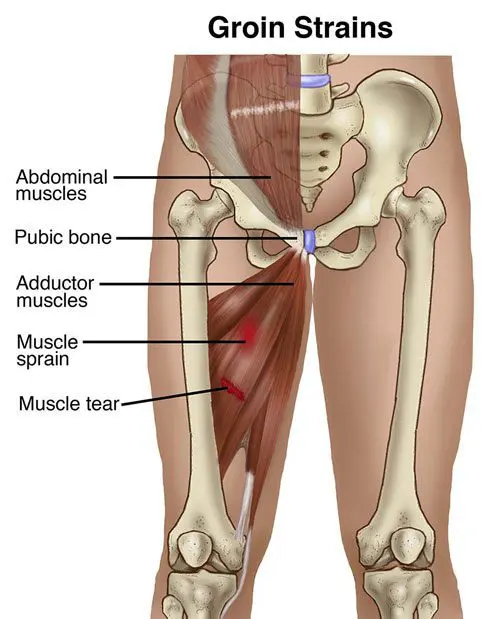 Groin pain may start after a heavy lift, quick pivot, long run, deep squat, or hours of sitting. Yet the painful region sits at a crossroads between the hip, pelvis, abdomen, spine, muscles, tendons, and nerves. Two people with similar pain may need different care.
Sports-medicine experts classify groin pain into adductor-related, iliopsoas-related, inguinal-related, pubic-related, hip-related, and other causes (Weir et al., 2015).
Why Groin Pain Can Be Hard to Pin Down
The groin is a region where several tissues share space and can refer symptoms. Pain may appear with walking, climbing, lifting, sitting, running, changing direction, coughing, or rolling in bed.
A useful first question is not simply, “Where does it hurt?” It is, “What makes it hurt, and what else happens with it?”
Clinicians may ask about:
- sudden versus gradual onset,
- clicking, catching, locking, or giving way,
- pain with coughing or straining,
- numbness, burning, or tingling,
- back pain or symptoms traveling into the thigh,
- bowel, urinary, or abdominal symptoms,
- recent changes in running, lifting, or work volume,
- fever, trauma, or inability to bear weight.
Those clues reshape diagnosis.
Hip-Joint Irritation Can Feel Like Groin Pain
Pain from inside the hip joint often presents as anterior hip or groin pain. Potential causes include osteoarthritis, labral injury, femoroacetabular impingement, or stress injury. Pain may increase with deep flexion, prolonged sitting, pivoting, or squatting (Chamberlain, 2021).
The examination includes gait, hip range of motion, and provocative movements. These may reproduce hip symptoms, but no single test proves the diagnosis. Imaging and the overall clinical picture matter.
Technicians and runners can have different generators despite similar symptoms.
Adductor and Hip-Flexor Problems
The adductors help control the leg during cutting, lifting, stepping, and stabilizing. Adductor-related groin pain becomes more likely when there is local tenderness and familiar pain with resisted adduction testing (Weir et al., 2015).
The iliopsoas, a major hip flexor, may become irritated with repeated hip flexion, uphill running, stair climbing, prolonged sitting, or high-volume lifting. Pain with resisted hip flexion or stretching can support an iliopsoas-related pattern.
Rehabilitation may include graded strengthening, hip and trunk control, progressive loading, and planned return to work or sport.
Could the Pain Be Coming From the Back or a Nerve?
Groin pain can occasionally refer from the lumbar spine or result from nerve irritation. A patient may describe back stiffness, thigh symptoms, burning, numbness, altered sensation, or pain that changes with spinal posture.
A neurological examination may assess strength, sensation, reflexes, neural tension, lumbar movement, and symptom reproduction. If neurological loss is progressive, severe, or paired with bowel or bladder changes, urgent medical evaluation is appropriate.
Chiropractic care may be useful when mechanical spinal or hip findings contribute, but diagnosis should precede treatment. The question is whether spinal mechanics are truly part of the case.
When a Hernia or Medical Cause Must Be Considered
An inguinal hernia may cause groin discomfort, pressure, aching, or a bulge that becomes more noticeable with lifting, coughing, or straining. Some hernias are obvious on examination; others may require ultrasound or MRI when suspicion remains high (Shakil et al., 2020).
Groin pain can also reflect abdominal, urologic, gynecologic, vascular, infectious, or other medical problems. Musculoskeletal treatment should not delay referral.
Seek prompt evaluation for severe or rapidly worsening pain, fever, a painful nonreducible groin bulge, vomiting, major trauma, inability to bear weight, unexplained swelling, or new bowel or bladder symptoms.
What the Examination Should Actually Include
Depending on the history, Dr. Alex Jimenez, DC, APRN, FNP-BC, CFMP, IFMCP, and the integrated team may assess:
- walking pattern and any limp,
- hip flexion, extension, rotation, and symmetry,
- adductor and hip-flexor strength,
- trunk and pelvic control,
- lumbar movement and neurological findings,
- pain with squat, step, lunge, or job-specific movement,
- abdominal or inguinal findings when medically appropriate.
This gold-standard multidisciplinary approach supports beneficence by identifying the likely pain generator, non-maleficence by avoiding unnecessary procedures, and autonomy by helping patients understand options before choosing their care.
When Imaging Helps
Imaging should answer a clinical question, not replace an examination. For chronic undifferentiated hip pain, standing pelvic and hip radiographs are generally appropriate as a first study. MRI may become important when a labral injury, stress fracture, avascular necrosis, tendon injury, or another condition is suspected (American College of Radiology, 2022; Chamberlain, 2021).
Ultrasound can be useful for selected tendon, soft-tissue, or hernia questions. The best test follows the clinical question.
Rehabilitation Remains the Foundation
After excluding serious medical causes, rehabilitation focuses on restoring capacity. A programmer who has lost hip mobility after prolonged sitting may need a different plan from a warehouse worker whose symptoms appear during loaded squats.
Treatment may combine:
- chiropractic or manual care when mechanical restrictions are relevant,
- progressive hip and trunk strengthening,
- adductor and hip-flexor loading,
- gait and movement retraining,
- mobility work,
- gradual return to lifting, climbing, running, or squatting,
- acupuncture or electroacupuncture when appropriate for pain modulation while active rehabilitation continues.
The objective is durable function.
Where PRP, PRF, or MFAT May Enter the Discussion
Orthobiologic procedures should not be the first answer to unexplained groin pain. They become a discussion only after the diagnosis is defined, conservative rehabilitation has been appropriately tried, and imaging or examination confirms a suitable tendon or joint problem.
Platelet-rich plasma has been studied for hip osteoarthritis, with systematic reviews reporting potential improvements in pain and function, although protocols and study quality vary (Almutairi & Alazzeh, 2024). PRF may be considered in selected tissue-healing strategies, but evidence depends on the exact diagnosis.
Researchers are studying microfragmented adipose tissue (MFAT) for hip osteoarthritis. Early hip studies are promising, but the evidence remains limited, and benefits appear incomplete rather than guaranteed (Zaffagnini et al., 2025). These options should support, not replace, strength, mobility, load progression, and shared decision-making.
A Coordinated Path Forward
Persistent groin pain deserves a diagnosis that respects its complexity. Dr. Jimenez’s dual chiropractic and advanced-practice medical training allows structural examination, neurological screening, medical diagnostics, and rehabilitation planning to connect rather than compete. Dr. Maria Guadalupe Cardenas, MD, provides internal-medicine oversight for complex medical conditions, laboratory questions, and referral coordination.
The patient remains the decision-maker. Care can be coordinated with an existing primary-care physician, orthopedist, surgeon, or other specialist when needed. The best plan may be conservative rehabilitation alone, additional imaging, medical workup, or selected advanced therapy.
If groin pain is limiting your work, running, lifting, climbing, or daily movement, schedule an integrated evaluation. The next step should be based on what is causing the pain—not simply where you feel it.
Hip Labral Tear Treatment | El Paso, TX
References
Almutairi, A. N., & Alazzeh, M. S. (2024). Efficacy and safety of platelet-rich plasma intra-articular injections in hip osteoarthritis: A systematic review of randomized clinical trials. Cureus, 16(10), e72057.
American College of Radiology. (2022). ACR Appropriateness Criteria®: Chronic hip pain.
Chamberlain, R. (2021). Hip pain in adults: Evaluation and differential diagnosis. American Family Physician, 103(2), 81–89.
Zaffagnini, M., Raggi, F., Carillo, E., Andriolo, L., Boffa, A., Cavallo, C., Cattini, L., Zaffagnini, S., & Filardo, G. (2025). Micro-fragmented adipose tissue for the treatment of hip osteoarthritis: A prospective pilot study at 1-year follow-up. Journal of Experimental Orthopaedics, 12(4), e70579.
Shakil, A., Aparicio, K., Barta, E., & Munez, K. (2020). Inguinal hernias: Diagnosis and management. American Family Physician, 102(8), 487–492.
Weir, A., Brukner, P., Delahunt, E., Ekstrand, J., Griffin, D., Khan, K. M., Lovell, G., Meyers, W. C., Muschaweck, U., Orchard, J., Paajanen, H., Philippon, M., Reboul, G., Robinson, P., Schache, A. G., Schilders, E., Serner, A., Silvers, H., Thorborg, K., … Hölmich, P. (2015). Doha agreement meeting on terminology and definitions in groin pain in athletes. British Journal of Sports Medicine, 49(12), 768–774.
Post Disclaimer
General Disclaimer, Licenses and Board Certifications *
Professional Scope of Practice *
The information herein on "Groin Pain Causes Workers to Change Work Habits" is not intended to replace a one-on-one relationship with a qualified health care professional or licensed physician and is not medical advice. We encourage you to make healthcare decisions based on your research and partnership with a qualified healthcare professional.
Blog Information & Scope Discussions
Welcome to El Paso's Premier Wellness and Injury Care Clinic & Wellness Blog, where Dr. Alex Jimenez, DC, FNP-C, a Multi-State board-certified Family Practice Nurse Practitioner (FNP-BC) and Chiropractor (DC), presents insights on how our multidisciplinary team is dedicated to holistic healing and personalized care. Our practice aligns with evidence-based treatment protocols inspired by integrative medicine principles, similar to those on this site and on our family practice-based chiromed.com site, focusing on naturally restoring health for patients of all ages.
Our areas of multidisciplinary practice include Wellness & Nutrition, Chronic Pain, Personal Injury, Auto Accident Care, Work Injuries, Back Injury, Low Back Pain, Neck Pain, Migraine Headaches, Sports Injuries, Severe Sciatica, Scoliosis, Complex Herniated Discs, Fibromyalgia, Chronic Pain, Complex Injuries, Stress Management, Functional Medicine Treatments, and in-scope care protocols.
Our information scope is multidisciplinary, focusing on musculoskeletal and physical medicine; wellness; contributing etiological viscerosomatic disturbances within clinical presentations; associated somato-visceral reflex clinical dynamics; subluxation complexes; sensitive health issues; and functional medicine articles, topics, and discussions.
We provide and present clinical collaboration with specialists from various disciplines. Each specialist follows their professional scope of practice and licensure jurisdiction. We use functional health & wellness protocols to treat and support care for musculoskeletal injuries or disorders.
Our videos, posts, topics, and insights address clinical matters and issues that directly or indirectly relate to our clinical scope of practice.
Our office has made a reasonable effort to provide supportive citations and has identified relevant research studies that support our posts. We provide copies of supporting research studies upon request to regulatory boards and the public.
For further discussion on how this information relates to specific care plans or treatment protocols, please ask Dr. Alex Jimenez, DC, APRN, FNP-BC, or contact us at 915-850-0900.
We are here to help you and your family.
Blessings
Dr. Alex Jimenez DC, MSACP, APRN, FNP-BC*, CCST, IFMCP, CFMP, ATN
Email: [email protected]
Multidisciplinary Licensing & Board Certifications:
Licensed as a Doctor of Chiropractic (DC) in Texas & New Mexico*
Chiropractic Licenses:
Texas DC License #: TX5807, Verified: TX5807
New Mexico DC License #: NM-DC2182, Verified: NM-DC2182
Nurse Practitioner Licenses:
Texas APRN License #: 1191402, Verified: 1191402 *
New Mexico CNP License #: 90560, Verified 90560
Florida APRN License #: 11043890, Verified: APRN11043890 *
Colorado License #: C-APN.0105610-C-NP, Verified: C-APN.0105610-C-NP
New York License #: N25929, Verified N25929
Georgia APRN License #: GAA-NP005701
Multi-State Advanced Practice Registered Nurse (APRN*) Texas & Multi-States
Multi-state Compact APRN License by Endorsement (43 States)
Compact Status: Multi-State License: Authorized to Practice in 43 States*
Nursing Licensure Compact: Updated Here
DEA Registration: (Drug Enforcement Agency Registered)
All medical (MDs) and family practice providers (FNP-APRN) are registered and licensed to offer various levels of medication.
Verify Providers' DEA Registration Here
License Verification Link: Nursys License Verifier
* Prescriptive Authority Authorized (DEA Registered Providers). Call if Required
Board Certification:
ANCC FNP-BC: Board Certified Nurse Practitioner*
Education:
Graduate with Honors: ICHS: MSN-FNP (Family Nurse Practitioner Program)
Degree Granted. Master's in Family Practice, MSN Diploma (Cum Laude)
Dr. Alex Jimenez, DC, APRN, FNP-BC*, CFMP, IFMCP, ATN, CCST
(Board Certified: Family Practice Nurse Practitioner—Multistate)*
(Licensed Nurse Practitioner & Chiropractor - Multistate)*
Clinical Director
DC & FNP License (Review Above)
Digital Business Card
NPI: 1205907805
Dr. Maria Cardenas, MD
(Board Certified: Internal Medicine)
(Licensed Medical Doctor)
Medical Director, Clinical Director & Collaborative Physician
NPI # 1164426748
MD License #: J2933
Licenses and Board Certifications:
MD: Medical Doctor
DC: Doctor of Chiropractic
APRNP: Advanced Practice Registered Nurse
FNP-BC: Family Practice Specialization (Multi-State Board Certified)
FNP-BC: Family Practice Across Life Span (Neonatal to Geriatrics)
RN: Registered Nurse (Multi-State Compact License)
CFMP: Certified Functional Medicine Provider
MSN-FNP: Master of Science in Family Practice Medicine
MSACP: Master of Science in Advanced Clinical Practice
IFMCP: Institute of Functional Medicine
CCST: Certified Chiropractic Spinal Trauma
ATN: Advanced Translational Neutrogenomics
Family with Primary Care Focus (Family Nurse Practitioner or FNP)
- The Family Nurse Practitioner (FNP) promotes, maintains, and restores health for individuals and families across the lifespan. FNPs also identify health risks, promote wellness, and diagnose and manage acute and chronic illness.
- The FNP focuses on comprehensive primary care, promoting healthy lifestyles for patients across the lifespan in settings such as private practice, physician offices, and community health centers.
Memberships & Associations:
TCA: Texas Chiropractic Association: Member ID: 104311
TNA: Texas Nurse Association: Member ID: 06458222
TNP: Texas Nurse Practitioner Association ID: 2025091511
AANP: American Association of Nurse Practitioners: Member ID: 2198960
ANA: American Nurses Association: Member ID: 06458222 (District TX01)
| Primary Taxonomy | Selected Taxonomy | State | License Number |
|---|---|---|---|
| No | 111N00000X - Chiropractor | NM | DC2182 |
| Yes | 111N00000X - Chiropractor | TX | DC5807 |
| Yes | 363LF0000X - Nurse Practitioner - Family | TX | 1191402 |
| Yes | 363LF0000X - Nurse Practitioner - Family | FL | 11043890 |
| Yes | 363LF0000X - Nurse Practitioner - Family | CO | C-APN.0105610-C-NP |
| Yes | 363LF0000X - Nurse Practitioner - Family | NY | N25929 |
| Yes | 363LF0000X - Nurse Practitioner - Family | NM |
90560 |
| Yes | 363LF0000X - Nurse Practitioner - Family | GA | GAA-NP005701 |
Dr. Alex Jimenez, DC, APRN, FNP-BC*, CFMP, IFMCP, ATN, CCST
(Board Certified: Family Practice Nurse Practitioner—Multistate)*
(Primary Care Across Lifespan—Neonatal / Pediatric / Adult / Geriatrics)
(Licensed Nurse Practitioner & Chiropractor - Multistate)*
Clinical Director
Digital Business Card
NPI: 1205907805
Dr. Maria Cardenas, MD
(Board Certified: Internal Medicine)*
(Licensed Medical Doctor)*
Medical Director, Clinical Director & Collaborative Physician
NPI # 1164426748
MD License #: J2933
📆 Schedule Appointment: Schedule 24/7 (Click Here)